
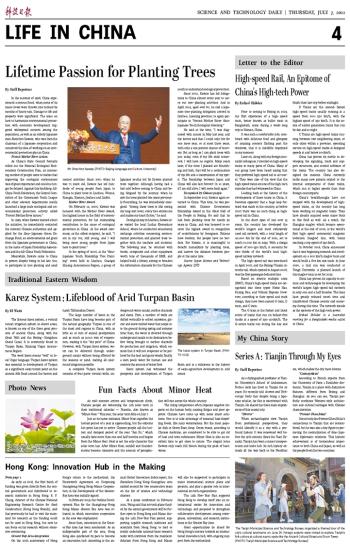


Prior to coming to Beijing in 2019, my first experience of a high-speed train, better known as bullet train in Bangladesh, came during a week-long trip to Hainan, China.
It was such a comfortable ride, combined with delicious food and glimpses of amazing scenery flashing past the windows, that it is indelibly imprinted in my memory.
Later on, along with my foreign journalist colleagues, I traveled on high-speed trains to many parts of China. Many of our group have been heard saying that they preferred high-speed rail to air travel. They were also of the view that the high-speed trains are one of the high-tech miracles they had witnessed in China.
Looking back at the history of the development of these trains in China, it becomes apparent that a huge leap forward was made in the country, as before 2007 there was no such thing as high-speed rail in China.
In the short span of just over 15 years, the country has developed the world's longest and most extensively used rail network, with a total length of 40,000 km by the end of 2021, set to reach 70,000 km in 2035. With a design speed of 200-350 km/h, it accounts for two-thirds of the world's total high-speed railway network.
The high-speed rail was introduced in April 2007, and the Beijing-Tianjin intercity rail, which opened in August 2008, was the first passenger dedicated line.
Based on electric multiple units (EMU), China's high-speed trains are categorized into three types: Hexie Hao, Fuxing Hao, and Vibrant Express. However, according to their speed and track design, they have been named G train, D train, and C train.
The G train is the fastest and latest series of trains that run on ballast-free tracks at a speed of 250-400km/h. The G-series trains run during the day and finish their last trip before midnight.
D Trains are the second-fastest high-speed trains usually running at a speed from 200-250 km/h, with the highest speed of 250 km/h. It is the series of earlier generation trains that run by day and at night.
C Trains are high-speed trains running between two neighboring cities, or only cities within a province, operating service on high-speed tracks at designed speeds at and below 200km/h.
China has proven its mettle in developing the signaling, track and support structures, and control software of the trains. The country has also designed the stations. China currently holds many new patents related to the internal components of these trains, which run at higher speeds than their foreign counterparts.
China's breakthroughs have not stopped with the development of high-speed trains, as the country has long been working on magnetic trains. They have already acquired some major feats in this field as well. As a result, the Shanghai maglev, which became operational at the end of 2002, is the world's first high-speed commercial magnetic levitation (maglev) line, with trains reaching a top speed of 430 km/h.
In October 2016, China announced that it was beginning research and development on a 600 km/h maglev train and would build a five km test track. In June 2020, a trial run was conducted at Tongji University. A planned launch of this maglev train is set for 2025.
China has proven its capacity in science and technologies by developing the world's largest high-speed rail network in only one and a half decades. The lines have greatly reduced travel time and transformed Chinese society and economy during this time. The network stands as the epitome of the high-tech power.
Ershad Shikdar is a journalist working for a Bangladeshi media outlet in China.