


 |
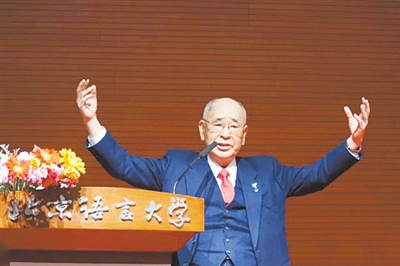
| Mr. Shoichiro Kawate. (PHOTO: Beijing Language and Culture University) |
In the summer of 1998, China experienced a serious flood, when some of its major rivers were thrown into turmoil by months of heavy rain. Damage to life and property were significant. The issue on how to harmonize environmental protection with economic development triggered widespread concern among the population, as well as an elderly Japanese man Shoichiro Kawate, who was then the chairman of a Japanese corporation and conceived the idea of working on an environmental protection plan in China.
Protect Mother River Action
As China's State Council formally rolled out the National Ecological Environment Construction Plan, an increasing number of people came to realize that improving the ecological environment was of great importance and could no longer be delayed. Against this backdrop, All-China Youth Federation, the Central Committee of the Communist Youth League and other relevant departments jointly launched a large scale ecological and environmental protection activity called "Protect Mother River Action."
In 1999, when Kawate learned about the initiative, he immediately contacted the relevant Chinese authorities and applied for the Sino-Japanese Green Exchange Fund, an environmental aid grant from the Japanese government to China, in the name of Japan Friendship Association and the All-China Youth Federation.
Meanwhile, Kawate came to China in person despite being in his late 60s, to participate in tree planting and sand control activities. Since 2001 when he was 71 years old, Kawate has led hundreds of young people from Japan to China to plant trees in Liuzhou, Wuxue, Xiaogan, Xiamen, Jinzhou and Linfen.
Mother River Award
On February 14, 2006, Kawate was honored with the Mother River Award, the highest honor in the field of environmental protection, for his outstanding contribution to the cause of ecological protection in China. At the award ceremony, as the oldest recipient, he said, "I am in my 70s, still young, and I will bring more young people from Japan here to plant trees."
In the spring of 2006, at the "Sino-Japanese Youth Friendship Tree Planting" event held in Liuzhou, Guangxi Zhuang Autonomous Region, a group of Japanese youths led by Kawate planted trees together. Although having had a bad cold before coming to China and being fatigued by the journey, when he saw the trees planted two years previously flourishing, he was immediately energized. "Seeing these trees is like seeing my long-lost lover, every tree excites me and makes my heart flutter," he said.
During his stay in Liuzhou, Kawate also visited the local Luzhai Elementary School, where he conducted educational exchange activities concerning environmental protection and planted trees together with the teachers and students. The following year, he returned with books, computers and other equipment worth tens of thousands of RMB, and helped build a library, aiming to broaden the information channels for the Chinese youth to understand ecological protection.
Since 2001, Kawate has led delegations to China almost every year to carry out tree-planting activities. And in April 2014, aged over 80, he and a Japanese tree-planting delegation arrived in Jinzhou, Liaoning province, to again participate in "Protect Mother River: Sino-Japanese Youth Ecological Greening."
He said at the time, "I was diagnosed with cancer in May last year, and the doctor said that I could only live for one more year, or at most three years, with only a one percent chance of recovery. But as long as I can plant trees with you today, even if my life ends tomorrow, I will have no regrets. Many years later, if the trees I planted are flourishing and lush, that will be a continuation of my life and a transmission of my spirit. The friendship between Japan and China will also last forever! In 10 years, if I am still alive, I will come back again."
Recognized by Chinese people
In September 2017, Kawate again returned to China. This time, he was presented with Chinese Government Friendship Award in the Great Hall of the People in Beijing. He said that he had been planting trees for nearly 30 years in China, and was honored to receive the highest award in recognition of contributions by foreigners. Nations have borders, but people have no borders. For Kawate, it is meaningful to benefit humankind by planting trees, and narrow the distance between people at the same time.
Source: Japan Science and Technology Agency (JST)