

 Next
Next


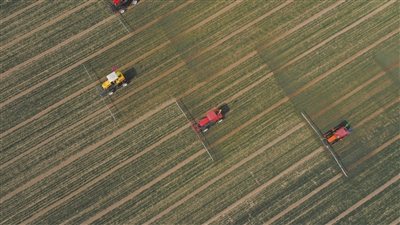 |
| Spraying machines in operation at a farm in Hebei province. (PHOTO: XINHUA) |
As China is at a historical juncture of moving toward its second centenary goal, agriculture, rural areas and farmers are high on the country's list of priorities.
Its "No. 1 central document" for 2022 unveiled on February 22, the first policy statement released by China's central authorities each year since 2004, outlines key tasks to comprehensively push forward rural vitalization this year.
Ten days earlier, another important document concerning agriculture, rural areas and farmers was released by the State Council.
The document, titled the Plan for Promoting Agricultural and Rural Modernization During the 14th Five-Year Plan Period, maps out the next steps towards the agricultural and rural modernization in the coming years.
The 14th Five-Year Plan period (2021-2025) is an important strategic opportunity for speeding up the process of such modernization, notes the plan.
It is China's first plan that integrates agricultural and rural modernization as a whole and aims to advance the two simultaneously, said Deng Xiaogang, vice minister of Agriculture and Rural Affairs during a policy briefing.
The country's work concerning agriculture, rural areas and farmers is undergoing a historical shift during the 14th Five-Year Plan period, said Deng, adding that rural vitalization in an all-around way has become the major task.
By 2025, the strategy of rural vitalization expects to be fully operational, with significant progress being made on agricultural and rural modernization, according to the goals set by the plan.
To measure such objectives, the plan proposes 17 key quantitative indexes in such fields as overall grain production capacity, total meat production, and high-standard farmland areas.
During 2021-2025, the contribution rate of agricultural sci-tech progress will grow four percent cumulatively to 64 percent.
Moreover, the comprehensive mechanization rate of crop cultivation and harvesting is expected to increase four percent to 75 percent in the same period.
Meanwhile, per capita disposable income of rural residents will rise with the pace of GDP growth in the next five years. During the 13th Five-Year plan period, the average per capita disposable income of rural residents reached 17,131 RMB, double than that of 2010.
To achieve these goals, the supporting role of sci-tech is greatly emphasized in the plan, calling for further promoting innovation in agricultural science and technology and deepening integration between sci-tech and agricultural sectors.
To yield more food in a limited arable land, science and technology is the key, while seed is the core, said Zeng Yande, chief agronomist of Ministry of Agriculture and Rural Affairs, adding that a large part of the growth in grain yield in recent years is owing to seed improvement.
Expanding the opening-up and international cooperation of agricultural sectors is also highlighted in the plan.
Focusing on food security, climate change and green development, China plans to actively take part in international cooperation in agricultural science and technology, and be heavily involved in the global governance of food and agriculture, said Wu Xiao, director general of the department of rural economy of the National Development and Reform Commission, adding that Belt and Road Initiative will play an important role in the high-level opening-up of the country's agricultural sectors.
By 2035, decisive progress is expected to be made in rural vitalization, and modernization of agriculture sectors and rural areas will be basically achieved, as per the plan.