


 |
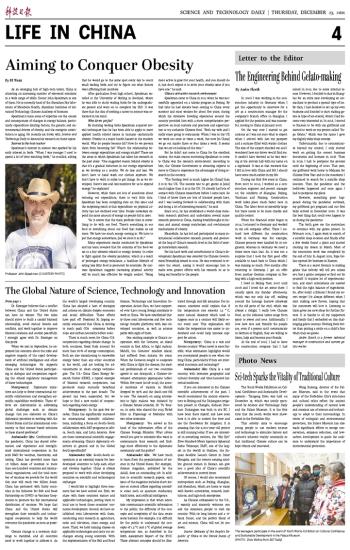
| Professor John Speakman. (COURTESY PHOTO) |
As an emerging hub of high-tech talent, China is attracting an increasing number of esteemed scientists in a wide range of skills. Doctor John Speakman is one of them. He is currently head of the Shenzhen Key laboratory of Metabolic Health, Shenzhen Institutes of Advanced Technology, Chinese Academy of Sciences.
Speakman's main areas of expertise are the causes and consequences of changes in energy balance, particularly expenditure-limiting factors, the genetic and environmental drivers of obesity, and the energetic contribution to aging. He recently sat down with Science and Technology Daily to discuss his research on these topics.
Interest is the best teacher
Speakman's interest in science was sparked by his early interest in birds. "When I was younger I used to spend a lot of time watching birds," he recalled, adding that he would go to the same spot every day to count small wading birds and try to figure out what factors were affecting their numbers.
After graduation from high school, Speakman enrolled at the University of Stirling in Scotland, where he was able to study wading birds for his undergraduate project and went on to complete his PhD. It was there that the idea of seeking a career in science was cemented in his mind.
Why do we get fat?
By studying wading birds Speakman acquired several techniques that he has been able to apply to more applied health related issues in humans -particularly obesity. Obesity is a major health hazard in the modern world. Why do people become fat? How do we prevent them from becoming fat? What's the relationship between energy expenditure and energy intake? These are the areas in which Speakman has taken his research in the past years. "One suggested reason behind obesity is that it's a gradual reduction in our energy expenditure as we develop as a society. We do less and less. We don't have to hand wash our clothes anymore. We don't have to walk 10 miles to get things. So as we developed, there's less and less incentive for us to expend energy," he explained.
However, while there are lots of anecdotes about reducing our expenditure, there is very little data. Speakman has been compiling data on this issue and the surprising result is that expenditure on physical activity has not declined over time. People nowadays expend the same amount of energy as people did in 1990.
"So it seems that the main problem then is something to do with our food. There's something in our food or something about our food that makes us eat more. We have too much energy coming in. We have to put that energy somewhere, [so] we store it as fat."
Many experiment results conducted by Speakman and his team revealed that fat contents of the food we eat is a key element related to energy density. In order to fight against the obesity pandemic, which is a result of prolonged energy imbalance, a healthier lifestyle of eating less fatty food is promoted by scientists. By contrast Speakman suggests increasing physical activity will be much less effective for weight control. "Being more active is great for your health, and you should do it, just don't expect it to solve your obesity issue if you have one." he said.
China's attractive research environment
Speakman came to China in 2011 when he was successfully appointed on a talents program in Beijing. By that time he had already been coming to China every summer and most winters for about five years, during which his extensive traveling experience around the country provided him with a more comprehensive perspective on local customs and practices and opportunities to try authentic Chinese food. "Both my wife and I really enjoy going to restaurants. When I was in the UK we went out once or twice a week, but now [in China] we go out maybe three or four times a week. It seems that we are on holiday all the time."
But he didn't just come to China for the excellent cuisine, the main reason motivating Speakman to come to China was the research environment. According to him, the Chinese Government is attracting experts to move to China to experience the advantages of doing research in the country.
"The funding level is much higher [in China] than it is in the UK. The success rate to get grants is [also] much higher than it is in the UK. I'd already had lots of contact with Chinese researchers before I came here. So I kind of knew there are lots of talented people here, and I was looking forward to collaborating with them and doing a lot of interesting research," he said.
Since 2011, he has established a world-class metabolic research platform and undertaken several major research projects in China, making breakthroughs in human and animal energy metabolism and evolutionary mechanisms of obesity.
Meanwhile, he has led and participated in many international collaborative research projects and promoted the leap of China's research level in the field of energy metabolism research.
For his hard work and contributions to China's development Speakman was awarded the Chinese Government Friendship Award in 2021. He was overjoyed to receive the award, saying it would encourage him to make even greater efforts with his research so as to bring real benefits to the people.