

 |
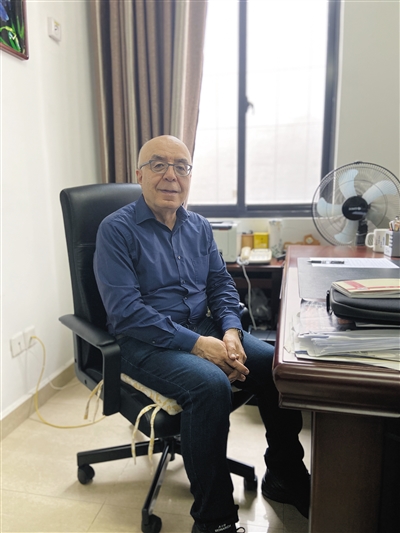
| Professor Ben-David Yaacov. (COURTESY PHOTO) |
Eight years ago, Ben-David Yaacov, a renowned Canadian medical scientist, moved to China with the hope of discovering a cure for cancer using a combination of Western and traditional Chinese medical practices.
On September 30 of this year, Yaacov received the Chinese Government Friendship Award at the Great Hall of the People in Beijing.
Speaking of his feelings as a recipient of the highest award for foreigners in China, Yaacov said he felt more respected for his scientific contribution in China than other places he has worked in.
Understanding TCM
Yaacov is not only notable for his achievements in anti-tumor pharmacology, but also for internationalizing traditional Chinese medicine (TCM).
Despite its time-honored history, TCM is still not widely accepted globally because few scientific studies have been done on it. He hopes to change the situation with his work and bridge the gap between TCM and Western medicine, to make more people fully aware of the working mechanism of Chinese herbal medicine.
"From my perspective, TCM has been mainly practical for thousands of years, but there is not enough understanding of its working principles," he told Science and Technology Daily.
After coming to China, Yaacov's understanding and appreciation of TCM has deepened.
"TCM as a precious part of Chinese culture, has not yet had enough influence in the world, and many people do not realize its excellence. For example, Western medicine has begun to emphasize 'personalized' treatment in recent years, but it has been valued in Chinese medicine for thousands of years. It seeks to restore balance through treatment specific to the individual," said Yaacov, adding that TCM's targeting function gives him more confidence for its international prospects.
The opportunity ahead
Since Yaacov put down roots in China's Guizhou province, he has been driven by his passion for new discoveries, especially TCM.
He is now the director of the cancer biology platform of the Laboratory for Chemistry of Natural Products, Chinese Academy of Sciences in Guizhou.
Yaacov's first visit to the laboratory was introduced by Yang Meili, one of his colleagues in Canada, who happened to be a former student of Hao Xiaojiang, director of the laboratory. In terms of his decision to choose Guizhou, Yaacov mentioned its ample resources of TCM and specialists with the knowledge of isolating pure compounds from natural herbal remedies.
"My original research in Canada was suspended because of a lack of funds. I planned to change my research direction to drug development for cancer treatment. It is exciting to conduct unexplored areas of study," he noted.
He said that experts here [in China] extract compounds from TCM and there has to be a biologist familiar with their functions, which is his area of expertise.
"Here I have access to everything new and locally sourced," he said, adding that Chinese scientist Tu Youyou, who won Nobel Prize in medicine for her research on an antimalarial substance, inspires him.
"I have been given sufficient support mentally and financially from my institution, and the people around me are quite nice," he said.
Connection with China
Yaacov applauded China's positive role in facilitating international cooperation in the sci-tech community. In recent years, China has taken measures to embrace more experts around the globe and accelerate international exchanges.
Currently living in Guiyang, he said he thoroughly enjoys the convenient life there. When talking about the high-tech applications in daily life, Yaacov said mobile payments in China are incredible and futuristic. He is also impressed by the changes happening in Guizhou and his institution.
Yaacov has taken advantage of his vast network of contacts to help Guizhou facilitate its international exchanges, including introducing top scientists to take part in conferences.
"I do want my friends to know the real China by telling them the stories [about what it's like] here all the time. I invite foreign scientists to attend the conferences here, and I have to bust the rumors about China on the Internet with more vivid examples," he said.