


 |
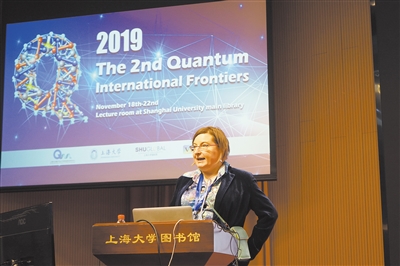
| Professor Malgorzata Biczysko is speaking at the 2nd Quantum International Frontiers. (PHOTO provided by author) |
I arrived in China for the first time in January 2015, to interview for a job at the International Center for Quantum and Molecular Structures, a then newly established department of Shanghai University (SHU).
Although I only spent three days in Shanghai, I liked it immediately.
My first impression of Shanghai was its unique atmosphere, where rapid development of modern technologies and traditional customs and beliefs lived side-by-side in harmony.
In my eyes, Shanghai is where you have the tallest skyscrapers, while around the corner people can be found sitting outside their homes playing mahjong (a traditional Chinese game). What is more, it is a city where you have elegant fine dining restaurants juxtaposed with street-food stands in front of them.
I have to say that much of the latter has disappeared since 2015, due to constant development of Shanghai.
However, some of the traditions still exist, which I hope will be preserved to retain Shanghai's unique integration of modernization and traditional cultures.
So, after considering what the city had to offer, along with quite exciting career opportunities at SHU, it was easy to commit to this new adventure and sign a 10-year contract with SHU.
I try my best to contribute to the internationalization and visibility of SHU by organizing several international conferences, such as the International Quantum Frontiers supported by SHU-Global.
One example of an on-going project is the China-Poland collaboration involving my friend Professor Qian Gou, who is the head of the microwave spectroscopy laboratory at Chongqing University.
She was also the person who introduced me to the Chinese spectroscopy and astrochemistry scientific communities.
In the future, I hope to continue contributing to new international collaborative opportunities, especially between China and European countries.
However, I think that the potential of foreign researchers is not yet exploited in full, as there is still room for improvement going forward.
One of the key obstacles is that sometimes it is not easy for foreign researchers to apply for joint research grants, while another issue hampering collaboration, not only international but also inside China, is related to the first authorship and first affiliation. This issue provides challenges for developing interdisciplinary projects.
In addition, available resources such as highly advanced computing or experimental facilities are not utilized to their full potential, due to missing or insufficient technical support.
In conclusion, I consider my stay in China a very interesting cultural and scientific experience.
I hope to have more possibilities to travel, and continue to learn Chinese language and culture.
My Chinese adventure is surely changing me as a person, broadening my scientific and human horizons and showing me how great and diverse is authentic Chinese cuisine.
(Professor Malgorzata Biczysko is from Poland and works at the Physics Department of Shanghai University College of Sciences. The views don't necessarily reflect those of the S&T Daily.)