

 Next


 |
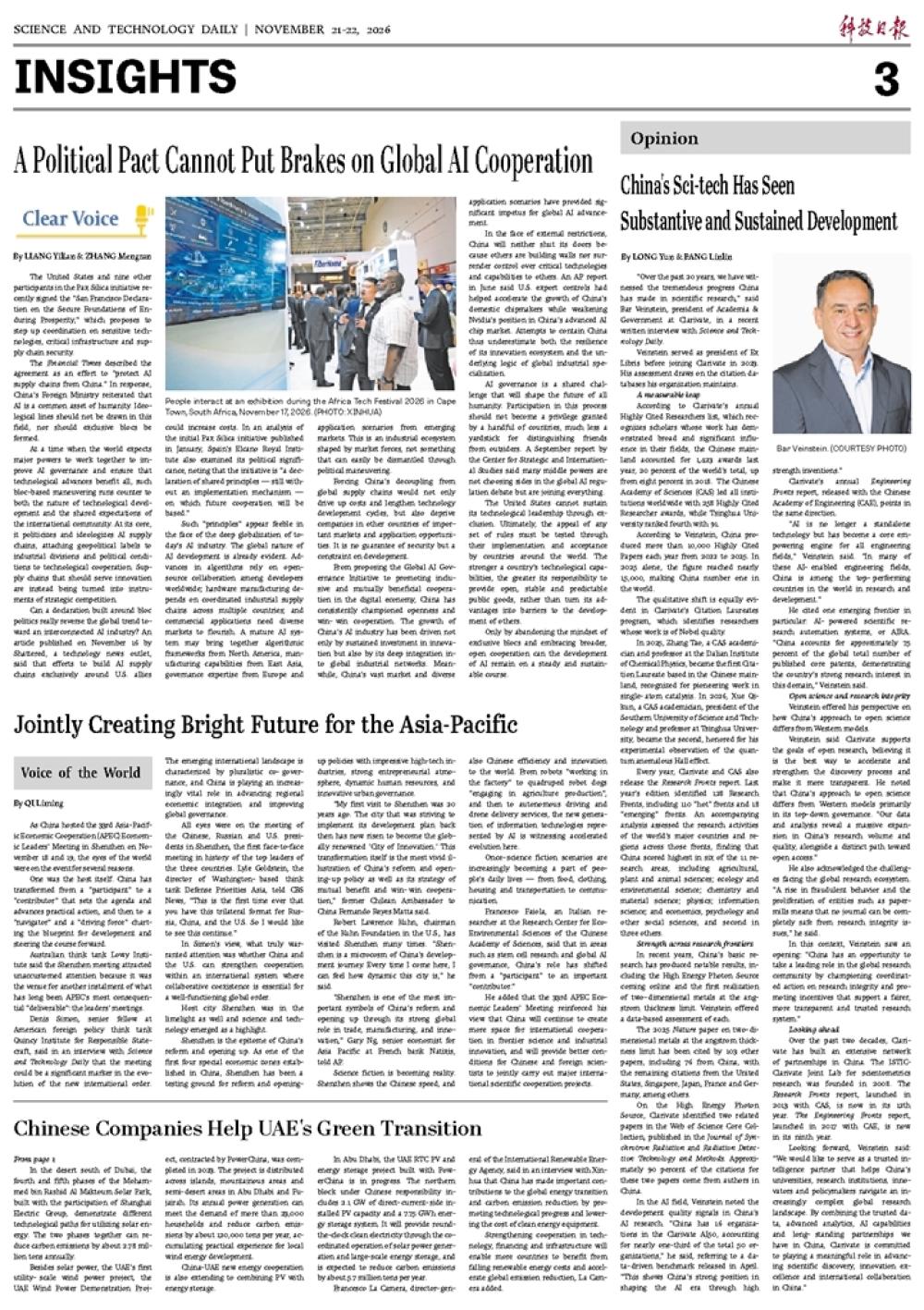
| People interact at an exhibition during the Africa Tech Festival 2026 in Cape Town, South Africa, November 17, 2026. (PHOTO: XINHUA) |
The United States and nine other participants in the Pax Silica initiative recently signed the "San Francisco Declaration on the Secure Foundations of Enduring Prosperity," which proposes to step up coordination on sensitive technologies, critical infrastructure and supply chain security.
The Financial Times described the agreement as an effort to "protect AI supply chains from China." In response, China's Foreign Ministry reiterated that AI is a common asset of humanity. Ideological lines should not be drawn in this field, nor should exclusive blocs be formed.
At a time when the world expects major powers to work together to improve AI governance and ensure that technological advances benefit all, such bloc-based maneuvering runs counter to both the nature of technological development and the shared expectations of the international community. At its core, it politicizes and ideologizes AI supply chains, attaching geopolitical labels to industrial divisions and political conditions to technological cooperation. Supply chains that should serve innovation are instead being turned into instruments of strategic competition.
Can a declaration built around bloc politics really reverse the global trend toward an interconnected AI industry? An article published on November 16 by Shattered, a technology news outlet, said that efforts to build AI supply chains exclusively around U.S. allies could increase costs. In an analysis of the initial Pax Silica initiative published in January, Spain's Elcano Royal Institute also examined its political significance, noting that the initiative is "a declaration of shared principles — still without an implementation mechanism — on which future cooperation will be based."
Such "principles" appear feeble in the face of the deep globalization of today's AI industry. The global nature of AI development is already evident. Advances in algorithms rely on open-source collaboration among developers worldwide; hardware manufacturing depends on coordinated industrial supply chains across multiple countries; and commercial applications need diverse markets to flourish. A mature AI system may bring together algorithmic frameworks from North America, manufacturing capabilities from East Asia, governance expertise from Europe and application scenarios from emerging markets. This is an industrial ecosystem shaped by market forces, not something that can easily be dismantled through political maneuvering.
Forcing China's decoupling from global supply chains would not only drive up costs and lengthen technology development cycles, but also deprive companies in other countries of important markets and application opportunities. It is no guarantee of security but a constraint on development.
From proposing the Global AI Governance Initiative to promoting inclusive and mutually beneficial cooperation in the digital economy, China has consistently championed openness and win-win cooperation. The growth of China's AI industry has been driven not only by sustained investment in innovation but also by its deep integration into global industrial networks. Meanwhile, China's vast market and diverse application scenarios have provided significant impetus for global AI advancement.
In the face of external restrictions, China will neither shut its doors because others are building walls nor surrender control over critical technologies and capabilities to others. An AP report in June said U.S. export controls had helped accelerate the growth of China's domestic chipmakers while weakening Nvidia's position in China's advanced AI chip market. Attempts to contain China thus underestimate both the resilience of its innovation ecosystem and the underlying logic of global industrial specialization.
AI governance is a shared challenge that will shape the future of all humanity. Participation in this process should not become a privilege granted by a handful of countries, much less a yardstick for distinguishing friends from outsiders. A September report by the Center for Strategic and International Studies said many middle powers are not choosing sides in the global AI regulation debate but are joining everything.
The United States cannot sustain its technological leadership through exclusion. Ultimately, the appeal of any set of rules must be tested through their implementation and acceptance by countries around the world. The stronger a country's technological capabilities, the greater its responsibility to provide open, stable and predictable public goods, rather than turn its advantages into barriers to the development of others.
Only by abandoning the mindset of exclusive blocs and embracing broader, open cooperation can the development of AI remain on a steady and sustainable course.