


 |
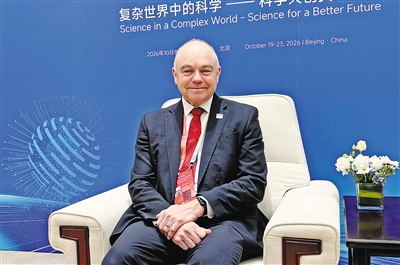 |
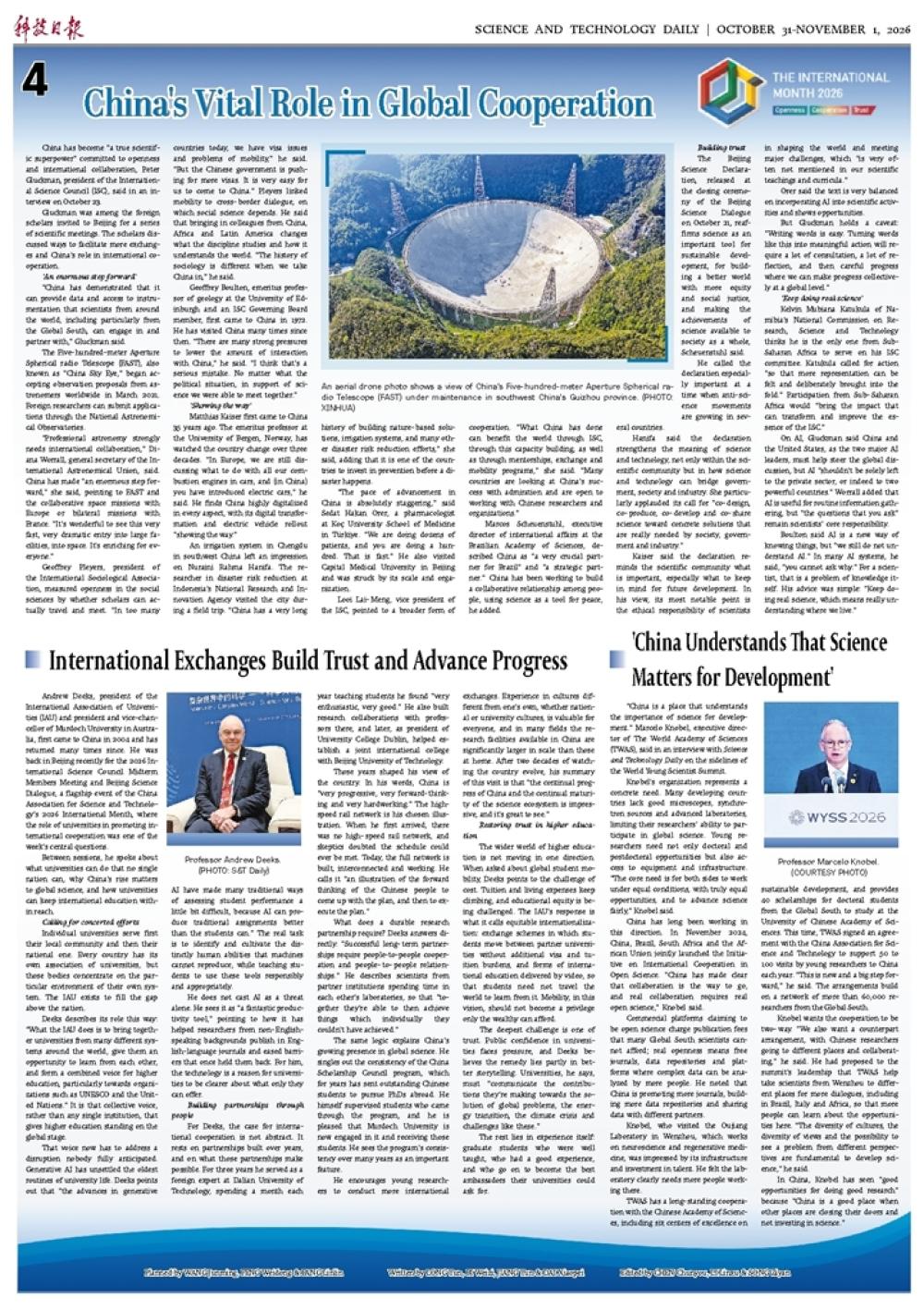
| Professor Andrew Deeks. (PHOTO: S&T Daily) |
Andrew Deeks, president of the International Association of Universities (IAU) and president and vice-chancellor of Murdoch University in Australia, first came to China in 2004 and has returned many times since. He was back in Beijing recently for the 2026 International Science Council Midterm Members Meeting and Beijing Science Dialogue, a flagship event of the China Association for Science and Technology's 2026 International Month, where the role of universities in promoting international cooperation was one of the week's central questions.
Between sessions, he spoke about what universities can do that no single nation can, why China's rise matters to global science, and how universities can keep international education within reach.
Calling for concerted efforts
Individual universities serve first their local community and then their national one. Every country has its own association of universities, but those bodies concentrate on the particular environment of their own system. The IAU exists to fill the gap above the nation.
Deeks describes its role this way: "What the IAU does is to bring together universities from many different systems around the world, give them an opportunity to learn from each other, and form a combined voice for higher education, particularly towards organizations such as UNESCO and the United Nations." It is that collective voice, rather than any single institution, that gives higher education standing on the global stage.
That voice now has to address a disruption nobody fully anticipated. Generative AI has unsettled the oldest routines of university life. Deeks points out that "the advances in generative AI have made many traditional ways of assessing student performance a little bit difficult, because AI can produce traditional assignments better than the students can." The real task is to identify and cultivate the distinctly human abilities that machines cannot reproduce, while teaching students to use these tools responsibly and appropriately.
He does not cast AI as a threat alone. He sees it as "a fantastic productivity tool," pointing to how it has helped researchers from non-English-speaking backgrounds publish in English-language journals and eased barriers that once held them back. For him, the technology is a reason for universities to be clearer about what only they can offer.
Building partnerships through people
For Deeks, the case for international cooperation is not abstract. It rests on partnerships built over years, and on what those partnerships make possible. For three years he served as a foreign expert at Dalian University of Technology, spending a month each year teaching students he found "very enthusiastic, very good." He also built research collaborations with professors there, and later, as president of University College Dublin, helped establish a joint international college with Beijing University of Technology.
Those years shaped his view of the country. In his words, China is "very progressive, very forward-thinking and very hardworking." The high-speed rail network is his chosen illustration. When he first arrived, there was no high-speed rail network, and skeptics doubted the schedule could ever be met. Today, the full network is built, interconnected and working. He calls it "an illustration of the forward thinking of the Chinese people to come up with the plan, and then to execute the plan."
What does a durable research partnership require? Deeks answers directly: "Successful long-term partnerships require people-to-people cooperation and people-to-people relationships." He describes scientists from partner institutions spending time in each other's laboratories, so that "together they're able to then achieve things which individually they couldn't have achieved."
The same logic explains China's growing presence in global science. He singles out the consistency of the China Scholarship Council program, which for years has sent outstanding Chinese students to pursue PhDs abroad. He himself supervised students who came through the program, and he is pleased that Murdoch University is now engaged in it and receiving those students. He sees the program's consistency over many years as an important feature.
He encourages young researchers to conduct more international exchanges. Experience in cultures different from one's own, whether national or university cultures, is valuable for everyone, and in many fields the research facilities available in China are significantly larger in scale than those at home. After two decades of watching the country evolve, his summary of this visit is that "the continual progress of China and the continual maturity of the science ecosystem is impressive, and it's great to see."
Restoring trust in higher education
The wider world of higher education is not moving in one direction. When asked about global student mobility, Deeks points to the challenge of cost. Tuition and living expenses keep climbing, and educational equity is being challenged. The IAU's response is what it calls equitable internationalization: exchange schemes in which students move between partner universities without additional visa and tuition burdens, and forms of international education delivered by video, so that students need not travel the world to learn from it. Mobility, in this vision, should not become a privilege only the wealthy can afford.
The deepest challenge is one of trust. Public confidence in universities faces pressure, and Deeks believes the remedy lies partly in better storytelling. Universities, he says, must "communicate the contributions they're making towards the solution of global problems, the energy transition, the climate crisis and challenges like these."
The rest lies in experience itself: graduate students who were well taught, who had a good experience, and who go on to become the best ambassadors their universities could ask for.