


 |
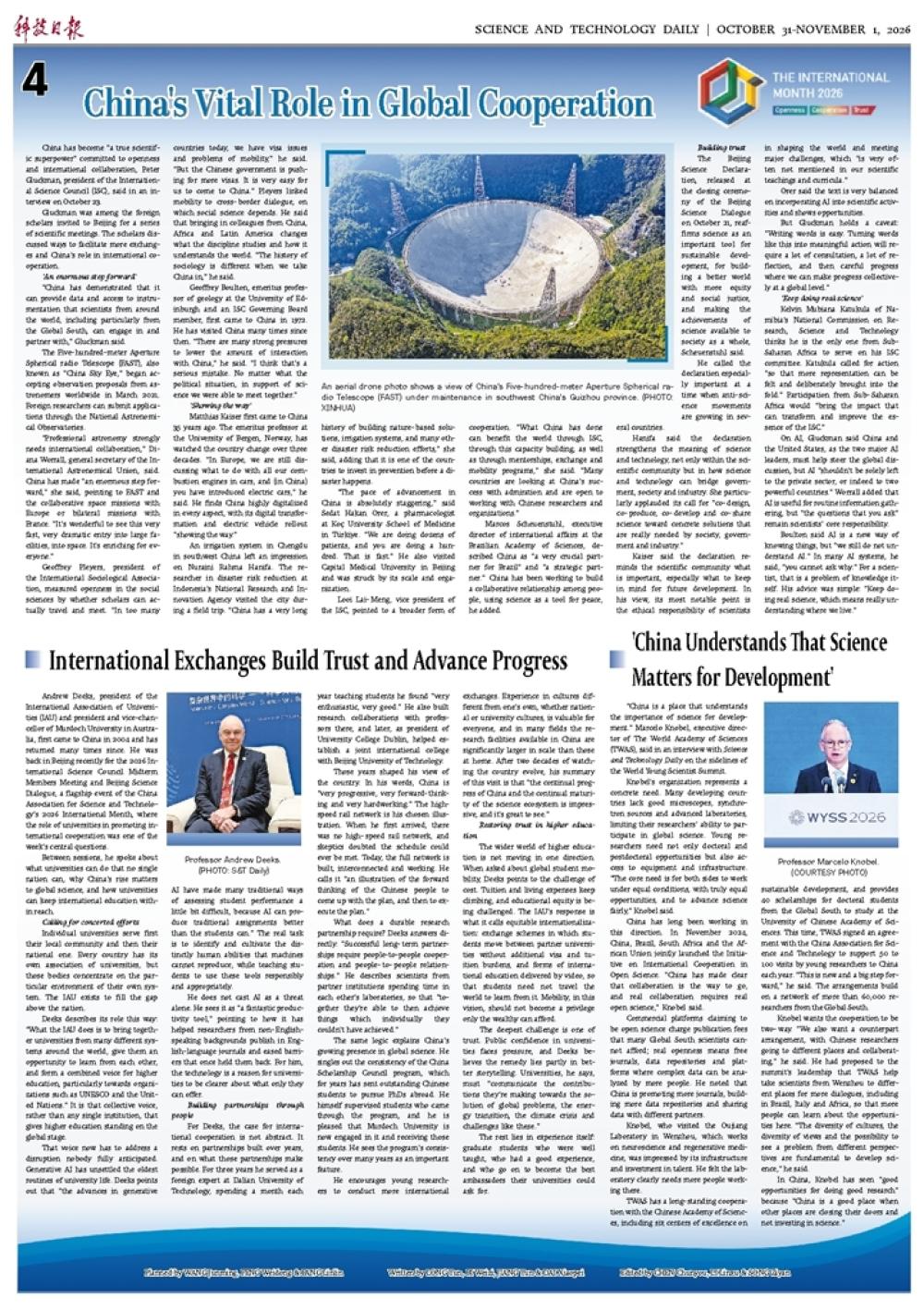
| An aerial drone photo shows a view of China's Five-hundred-meter Aperture Spherical radio Telescope (FAST) under maintenance in southwest China's Guizhou province. (PHOTO: XINHUA) |
China has become "a true scientific superpower" committed to openness and international collaboration, Peter Gluckman, president of the International Science Council (ISC), said in an interview on October 23.
Gluckman was among the foreign scholars invited to Beijing for a series of scientific meetings. The scholars discussed ways to facilitate more exchanges and China's role in international cooperation.
'An enormous step forward'
"China has demonstrated that it can provide data and access to instrumentation that scientists from around the world, including particularly from the Global South, can engage in and partner with," Gluckman said.
The Five-hundred-meter Aperture Spherical radio Telescope (FAST), also known as "China Sky Eye," began accepting observation proposals from astronomers worldwide in March 2021. Foreign researchers can submit applications through the National Astronomical Observatories.
"Professional astronomy strongly needs international collaboration," Diana Worrall, general secretary of the International Astronomical Union, said. China has made "an enormous step forward," she said, pointing to FAST and the collaborative space missions with Europe or bilateral missions with France. "It's wonderful to see this very fast, very dramatic entry into large facilities, into space. It's enriching for everyone."
Geoffrey Pleyers, president of the International Sociological Association, measured openness in the social sciences by whether scholars can actually travel and meet. "In too many countries today, we have visa issues and problems of mobility," he said. "But the Chinese government is pushing for more visas. It is very easy for us to come to China." Pleyers linked mobility to cross-border dialogue, on which social science depends. He said that bringing in colleagues from China, Africa and Latin America changes what the discipline studies and how it understands the world. "The history of sociology is different when we take China in," he said.
Geoffrey Boulton, emeritus professor of geology at the University of Edinburgh and an ISC Governing Board member, first came to China in 1972. He has visited China many times since then. "There are many strong pressures to lower the amount of interaction with China," he said. "I think that's a serious mistake. No matter what the political situation, in support of science we were able to meet together."
'Showing the way'
Matthias Kaiser first came to China 35 years ago. The emeritus professor at the University of Bergen, Norway, has watched the country change over three decades. "In Europe, we are still discussing what to do with all our combustion engines in cars, and (in China) you have introduced electric cars," he said. He finds China highly digitalized in every aspect, with its digital transformation and electric vehicle rollout "showing the way."
An irrigation system in Chengdu in southwest China left an impression on Nuraini Rahma Hanifa. The researcher in disaster risk reduction at Indonesia's National Research and Innovation Agency visited the city during a field trip. "China has a very long history of building nature-based solutions, irrigation systems, and many other disaster risk reduction efforts," she said, adding that it is one of the countries to invest in prevention before a disaster happens.
"The pace of advancement in China is absolutely staggering," said Sedat Hakan Orer, a pharmacologist at Ko? University School of Medicine in Türkiye. "We are doing dozens of patients, and you are doing a hundred. That is fast." He also visited Capital Medical University in Beijing and was struck by its scale and organization.
Looi Lai-Meng, vice president of the ISC, pointed to a broader form of cooperation. "What China has done can benefit the world through ISC, through this capacity building, as well as through mentorships, exchange and mobility programs," she said. "Many countries are looking at China's success with admiration and are open to working with Chinese researchers and organizations."
Marcos Scheuenstuhl, executive director of international affairs at the Brazilian Academy of Sciences, described China as "a very crucial partner for Brazil" and "a strategic partner." China has been working to build a collaborative relationship among people, using science as a tool for peace, he added.
Building trust
The Beijing Science Declaration, released at the closing ceremony of the Beijing Science Dialogue on October 21, reaffirms science as an important tool for sustainable development, for building a better world with more equity and social justice, and making the achievements of science available to society as a whole, Scheuenstuhl said.
He called the declaration especially important at a time when anti-science movements are growing in several countries.
Hanifa said the declaration strengthens the meaning of science and technology, not only within the scientific community but in how science and technology can bridge government, society and industry. She particularly applauded its call for "co-design, co-produce, co-develop and co-share science toward concrete solutions that are really needed by society, government and industry."
Kaiser said the declaration reminds the scientific community what is important, especially what to keep in mind for future development. In his view, its most notable point is the ethical responsibility of scientists in shaping the world and meeting major challenges, which "is very often not mentioned in our scientific teachings and curricula."
Orer said the text is very balanced on incorporating AI into scientific activities and shows opportunities.
But Gluckman holds a caveat: "Writing words is easy. Turning words like this into meaningful action will require a lot of consultation, a lot of reflection, and then careful progress where we can make progress collectively at a global level."
'Keep doing real science'
Kelvin Mubiana Katukula of Namibia's National Commission on Research, Science and Technology thinks he is the only one from Sub-Saharan Africa to serve on his ISC committee. Katukula called for action "so that more representation can be felt and deliberately brought into the fold." Participation from Sub-Saharan Africa would "bring the impact that can transform and improve the essence of the ISC."
On AI, Gluckman said China and the United States, as the two major AI leaders, must help steer the global discussion, but AI "shouldn't be solely left to the private sector, or indeed to two powerful countries." Worrall added that AI is useful for routine information gathering, but "the questions that you ask" remain scientists' core responsibility.
Boulton said AI is a new way of knowing things, but "we still do not understand AI." In many AI systems, he said, "you cannot ask why." For a scientist, that is a problem of knowledge itself. His advice was simple: "Keep doing real science, which means really understanding where we live."