

 Next
Next


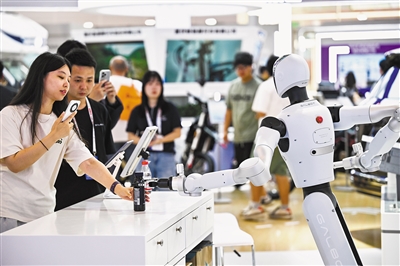 |
| Visitors interact with an embodied intelligent robot during the 2026 World Intelligence Expo held in Tianjin, May 29. (PHOTO: XINHUA) |
Recently, Reuters published a lengthy report titled "From dance floor to war: China readies humanoid robots for combat." The report opened with last month's second World Humanoid Robot Games in Beijing, where robots ran, boxed and danced as spectators cheered the machines' improving capabilities and their meme-worthy stumbles.
The tone then changed sharply. Reuters said it had reviewed more than 100 Chinese military procurement notices, academic studies, patents, official publications, government records and defense-company materials, and concluded that Chinese military institutions were testing humanoid robots for battlefield requirements. The report was quickly followed by coverage by other Western media outlets, and the headlines were overnight full of a supposed "Chinese robot army."
Yet the Reuters report had to acknowledge a crucial fact: There is no evidence that China has deployed an armed humanoid with an operational People's Liberation Army unit. If there is no such evidence, where does the claim that China is "preparing" humanoid robots for war come from? Public procurement notices, academic papers and corporate patents have been selectively assembled into a ready-made picture of "military preparations."
This narrative is hardly unfamiliar. A 2022 report by the Washington, D.C.-headquartered Quincy Institute for Responsible Statecraft, titled "Threat Inflation and the Chinese Military," warned that portraying China's military challenge in categorical, alarmist and worst-case terms effectively means "China becomes 10 feet tall." The report argued that such threat inflation can be more dangerous than underestimating a threat. Years later, the old script has simply acquired a new prop: humanoid robots.
So who is actually trying to put humanoid robots on the battlefield? The answer is not China. A look at recent Western media reports makes that clear.
A March 2026 investigation by TIME reported on a San Francisco-based startup called Foundation Future Industries, which is developing the Phantom MK-1 humanoid robot for military applications. Two Phantom MK-1 robots were sent to Ukraine in February, initially for frontline reconnaissance support.
A May report by CNBC provided further evidence of the U.S. military's involvement. Foundation Future Industries has received about 24 million USD in U.S. government research contracts covering inspection, logistics and weapons-handling feasibility work involving the Army, Navy and Air Force. The company described its deployment of two Phantom MK-1 units in Ukraine as "the first known deployment of humanoid robots in a combat theater," while CEO Sankaet Pathak said he aimed to deploy the technology with the U.S. military and, if needed, "on the front lines of conflicts" within the next 12 to 18 months.
Earlier, the Pentagon awarded AI contracts worth up to 200 million USD each to four Silicon Valley giants including Google and OpenAI, with the U.S. Department of Defense officials openly stating the aim was to "maintain strategic advantage over our adversaries." Sending its own robots into real battlefields while making a fuss over other countries' advanced technology research smacks of incredible double standard.
Putting the rhetoric aside, how close are humanoid robots to actual combat? The industry itself remains considerably more cautious. A December 2025 Wall Street Journal report was bluntly titled "Even the Companies Making Humanoid Robots Think They're Overhyped."
A March study by the Center for Strategic and International Studies on the Ukraine battlefield acknowledged that AI faces a "significant gap between aspiration and reality," with problems such as sensor failures in harsh weather and difficulty tracking fast-moving targets still unresolved. Even analysts at the Australian Strategic Policy Institute, which has consistently taken a hard line on China, conceded amid the hype that humanoid robots are currently not a "practical battlefield system" and may not be for another five to 10 years.
That is precisely why the most realistic and humane role for humanoid robots at this stage is to enter toxic zones and collapsed buildings in place of humans — taking over the most dangerous jobs. To portray such technological exploration as a robot army marching to the front lines is either ignorance or deliberate distortion.
What truly warrants vigilance has never been any single country's laboratory, but the runaway competition in the militarization of artificial intelligence.
Researchers at the research organization RAND Europe have warned that hype around military AI could fuel an "arms race" narrative around military AI and increase the possibility of unintended escalation during a crisis.
UN Secretary-General António Guterres made it plain at the Global Dialogue on AI Governance in Geneva this July: "Let us call them what they are: Killer robots. Machines selecting and engaging their target and taking a life —without human control and judgment. That is morally repugnant. It is politically unacceptable. And it must be banned by international law."
That is the conversation the international community needs: major powers sitting down to establish rules and shared understandings, rather than scrutinizing another country's procurement notices for evidence to justify confrontation. Instead of inventing a "robot army" for someone else, perhaps the world should confront the more fundamental question of our time: Do we really want to teach robots how to pull the trigger?