


 |
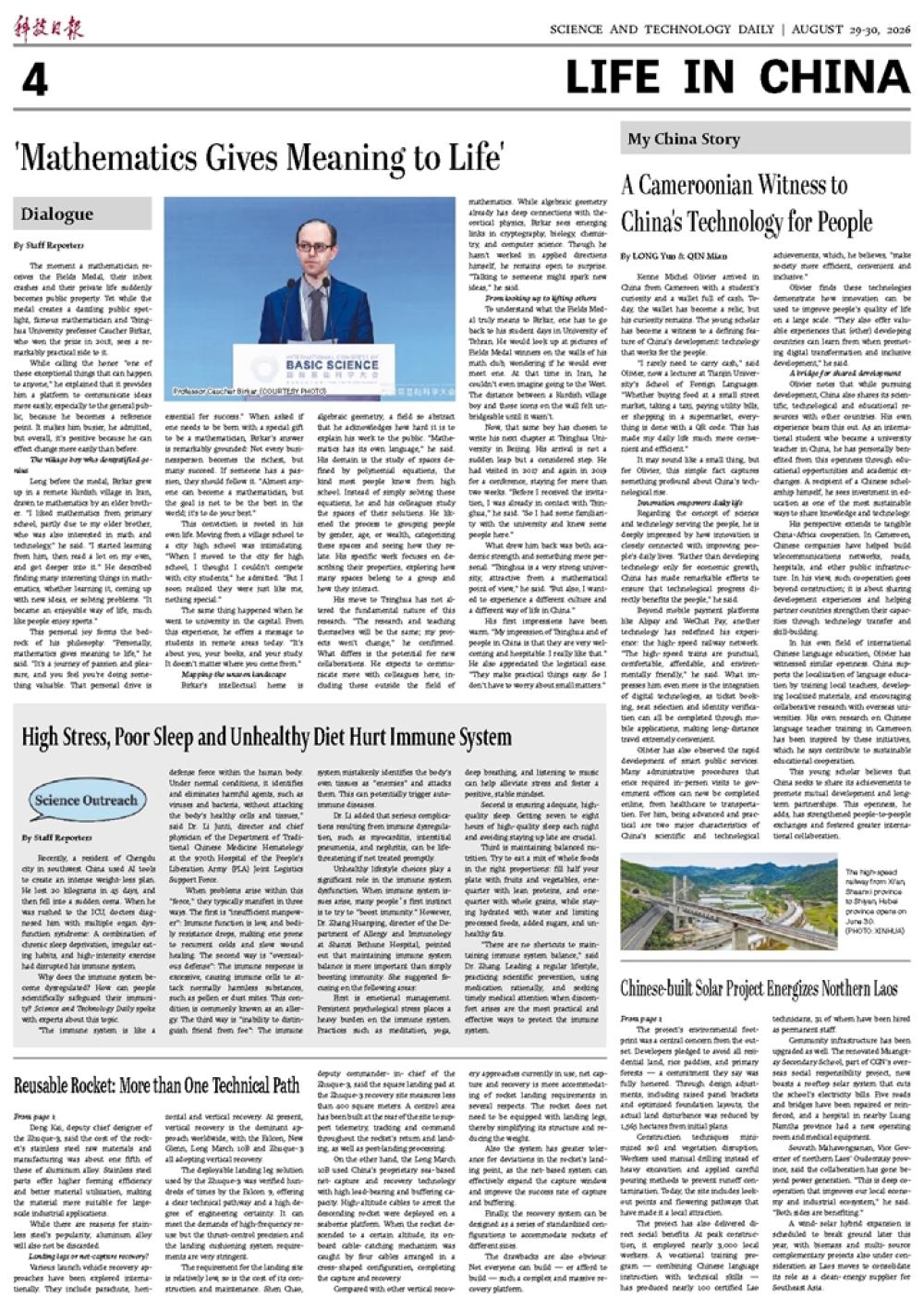
| The high-speed railway from Xi'an, Shaanxi province to Shiyan, Hubei province opens on June 30. (PHOTO: XINHUA) |
Kenne Michel Olivier arrived in China from Cameroon with a student's curiosity and a wallet full of cash. Today, the wallet has become a relic, but his curiosity remains. The young scholar has become a witness to a defining feature of China's development: technology that works for the people.
"I rarely need to carry cash," said Olivier, now a lecturer at Tianjin University's School of Foreign Languages. "Whether buying food at a small street market, taking a taxi, paying utility bills, or shopping in a supermarket, everything is done with a QR code. This has made my daily life much more convenient and efficient."
It may sound like a small thing, but for Olivier, this simple fact captures something profound about China's technological rise.
Innovation empowers daily life
Regarding the concept of science and technology serving the people, he is deeply impressed by how innovation is closely connected with improving people's daily lives. "Rather than developing technology only for economic growth, China has made remarkable efforts to ensure that technological progress directly benefits the people," he said.
Beyond mobile payment platforms like Alipay and WeChat Pay, another technology has redefined his experience: the high-speed railway network. "The high-speed trains are punctual, comfortable, affordable, and environmentally friendly," he said. What impresses him even more is the integration of digital technologies, as ticket booking, seat selection and identity verification can all be completed through mobile applications, making long-distance travel extremely convenient.
Olivier has also observed the rapid development of smart public services. Many administrative procedures that once required in-person visits to government offices can now be completed online, from healthcare to transportation. For him, being advanced and practical are two major characteristics of China's scientific and technological achievements, which, he believes, "make society more efficient, convenient and inclusive."
Olivier finds these technologies demonstrate how innovation can be used to improve people's quality of life on a large scale. "They also offer valuable experiences that (other) developing countries can learn from when promoting digital transformation and inclusive development," he said.
A bridge for shared development
Olivier notes that while pursuing development, China also shares its scientific, technological and educational resources with other countries. His own experience bears this out. As an international student who became a university teacher in China, he has personally benefited from this openness through educational opportunities and academic exchanges. A recipient of a Chinese scholarship himself, he sees investment in education as one of the most sustainable ways to share knowledge and technology.
His perspective extends to tangible China-Africa cooperation. In Cameroon, Chinese companies have helped build telecommunications networks, roads, hospitals, and other public infrastructure. In his view, such cooperation goes beyond construction; it is about sharing development experiences and helping partner countries strengthen their capacities through technology transfer and skill-building.
In his own field of international Chinese language education, Olivier has witnessed similar openness. China supports the localization of language education by training local teachers, developing localized materials, and encouraging collaborative research with overseas universities. His own research on Chinese language teacher training in Cameroon has been inspired by these initiatives, which he says contribute to sustainable educational cooperation.
This young scholar believes that China seeks to share its achievements to promote mutual development and long-term partnerships. This openness, he adds, has strengthened people-to-people exchanges and fostered greater international collaboration.