


 |
| Figure 2 |
 |
| Figure 3 |
 |
| Figure 1 |
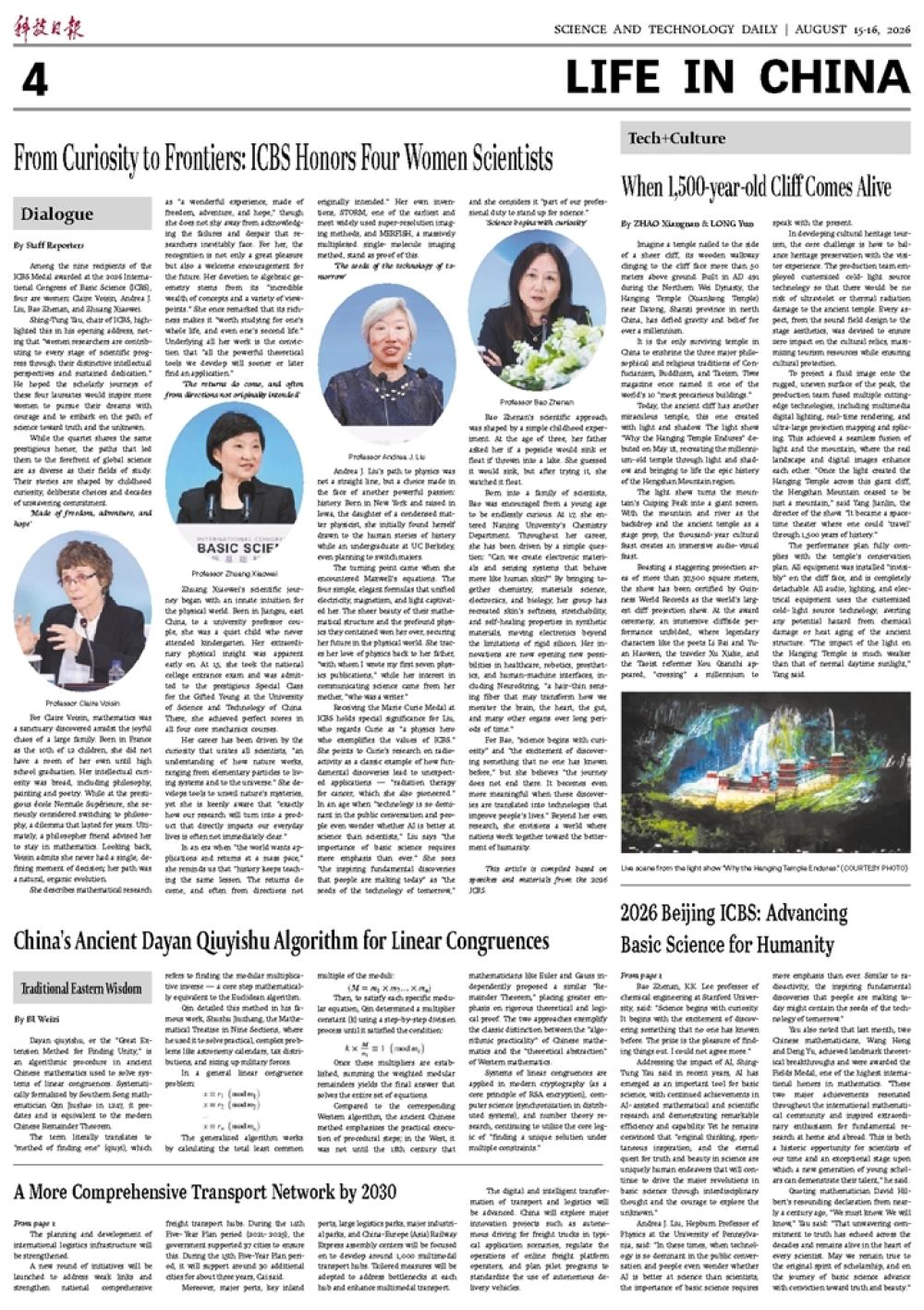
Dayan qiuyishu, or the "Great Extension Method for Finding Unity," is an algorithmic procedure in ancient Chinese mathematics used to solve systems of linear congruences. Systematically formalized by Southern Song mathematician Qin Jiushao in 1247, it predates and is equivalent to the modern Chinese Remainder Theorem.
The term literally translates to "method of finding one" (qiuyi), which refers to finding the modular multiplicative inverse — a core step mathematically equivalent to the Euclidean algorithm.
Qin detailed this method in his famous work, Shushu Jiuzhang, the Mathematical Treatise in Nine Sections, where he used it to solve practical, complex problems like astronomy calendars, tax distributions, and sizing up military forces.
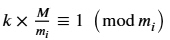
In a general linear congruence problem:(Figure 1)
The generalized algorithm works by calculating the total least common multiple of the moduli:(Figure 2)
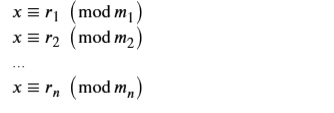
Then, to satisfy each specific modular equation, Qin determined a multiplier constant (k) using a step-by-step division process until it satisfied the condition:(Figure 3)
Once these multipliers are established, summing the weighted modular remainders yields the final answer that solves the entire set of equations.
Compared to the corresponding Western algorithm, the ancient Chinese method emphasizes the practical execution of procedural steps; in the West, it was not until the 18th century that mathematicians like Euler and Gauss independently proposed a similar "Remainder Theorem," placing greater emphasis on rigorous theoretical and logical proof. The two approaches exemplify the classic distinction between the "algorithmic practicality" of Chinese mathematics and the "theoretical abstraction" of Western mathematics.
Systems of linear congruences are applied in modern cryptography (as a core principle of RSA encryption), computer science (synchronization in distributed systems), and number theory research, continuing to utilize the core logic of "finding a unique solution under multiple constraints."