

 Next
Next


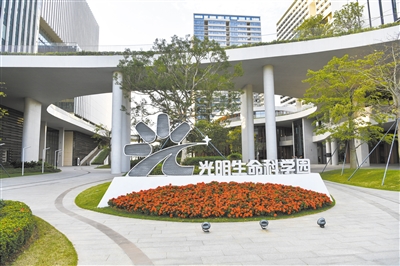 |
| A view of the Guangming Life Science Park in Shenzhen, Guangdong province, home to advanced life science research facilities. (PHOTO: XINHUA) |
China's southern tech hub Shenzhen is doubling down on basic research as it pushes to strengthen its innovation foundation and secure a leading position in frontier science.
Recently, the Shenzhen Institutes of Advanced Technology (SIAT) of the Chinese Academy of Sciences, together with more than 100 laboratories from six Asian countries, unveiled Asia's first 10-year roadmap for synthetic cells. The roadmap focuses on creating an artificial single-celled biological system, one of the world's most advanced scientific frontiers.
"This marks a key leap for China in basic research on synthetic life and synthetic cells, and demonstrates the country's determination to make greater contributions to this field through open cooperation," said SIAT president Liu Chenli.
Breakthroughs in basic research rest on a foundation of long-term, patient capital. Since 2020, Shenzhen has mandated by law that at least 30 percent of its municipal science and technology R&D funds will go to basic research and applied basic research. The city has also improved its funding mechanism by combining competitive grants with stable fund support.
"Quantum technology demands high investment and long cycles. Basic research funding is vital for building world-class infrastructure, attracting top talent and nurturing future industries," said Liu Song, vice dean of the Shenzhen International Quantum Academy.
Shenzhen is strengthening its R&D system through high spending and diversified policies. Its 15th Five-Year Plan (2026-2030) calls for accelerating AI applications across all industries, leveraging both hardware and software strengths to become a pioneering AI-powered city.
T&S Communications, a local company, is developing new optical communication equipment to meet the surging demand from the AI market. "With policy and financial support, we have succeeded in packing hundreds of optical fibers onto flexible boards, achieving an ultra-fineness thinner than a strand of hair, as well as their mass production and sales," said Hou Dan, the firm's technical director.
In recent years, Shenzhen's annual public budget spending on science and technology has averaged more than 40 billion RMB, accounting for over nine percent. The funds are used to support national and provincial laboratories and other innovation platforms to pursue original and leading-edge research.
In promoting innovation, Shenzhen puts enterprises in the driver's seat, channeling over 60 percent of its municipal R&D funds directly to support corporate R&D.
During the 15th Five-Year Plan period, the city will steer more innovation resources toward enterprises, roll out incentives to boost corporate R&D, expand its enterprise innovation credit system that channels precise funding to high-potential innovators, and mobilize venture, patient, international and industrial capital into key technological fields.
Official data shows Shenzhen's basic research investment has grown at an average annual rate of 19.7 percent over the past three years. The city's 15th Five-Year Plan targets to raise its R&D intensity to seven percent of GDP by 2030, boosting basic research and original innovation while integrating education, science and technology, and talent to improve overall innovation efficiency.
"Shenzhen has gone through a phase of catch-up innovation and is now entering the uncharted territory of original innovation," said Zhang Lin, director-general of the Shenzhen Municipal Science, Technology and Innovation Bureau. "By setting clear quantitative targets, we demonstrate our determination to invest in basic research and deliver more original results."