

 Next
Next


 |
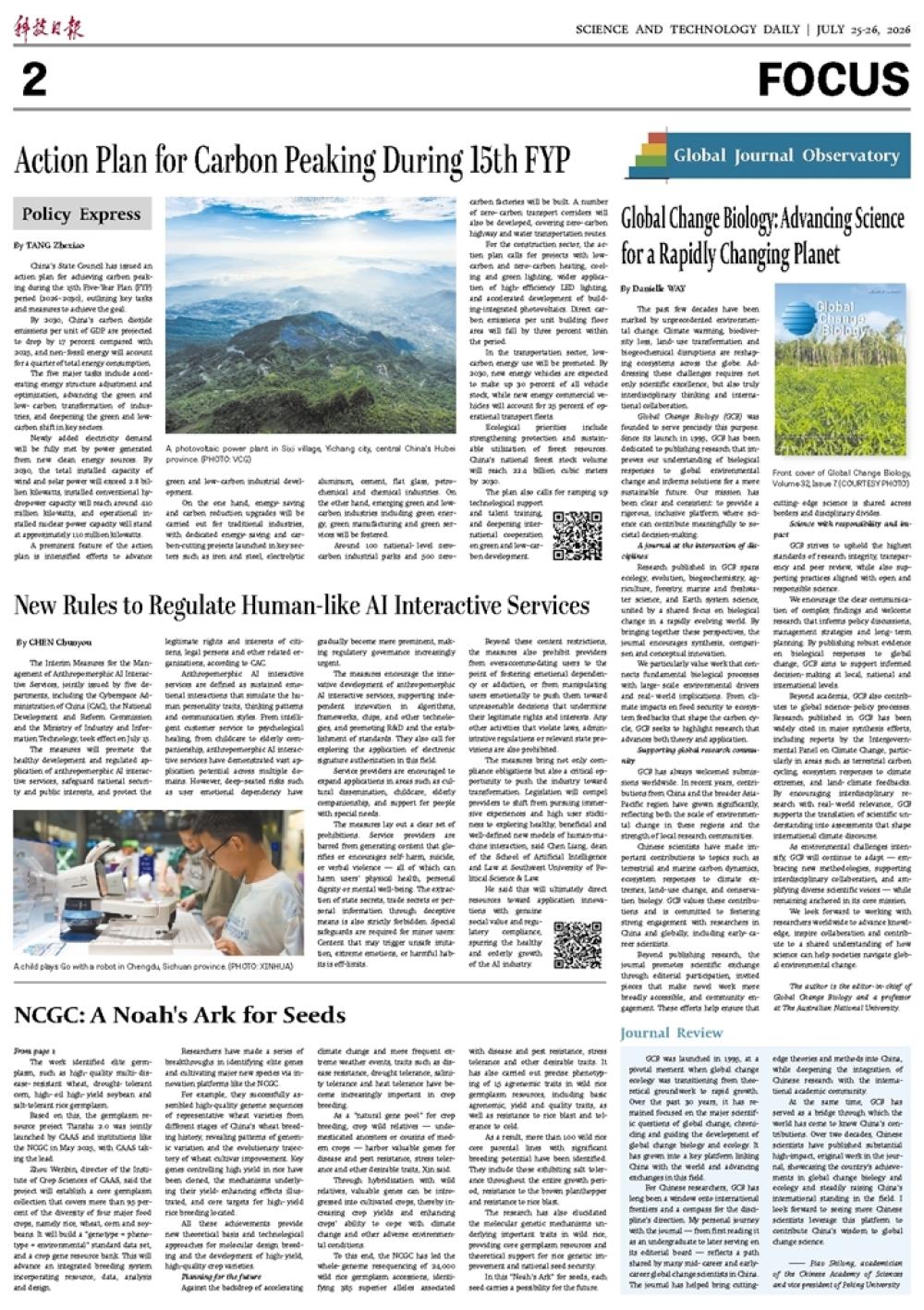
| A photovoltaic power plant in Sixi village, Yichang city, central China's Hubei province. (PHOTO: VCG) |
 |
China's State Council has issued an action plan for achieving carbon peaking during the 15th Five-Year Plan (FYP) period (2026-2030), outlining key tasks and measures to achieve the goal.
By 2030, China's carbon dioxide emissions per unit of GDP are projected to drop by 17 percent compared with 2025, and non-fossil energy will account for a quarter of total energy consumption.
The five major tasks include accelerating energy structure adjustment and optimization, advancing the green and low-carbon transformation of industries, and deepening the green and low-carbon shift in key sectors.
Newly added electricity demand will be fully met by power generated from new clean energy sources. By 2030, the total installed capacity of wind and solar power will exceed 2.8 billion kilowatts, installed conventional hydropower capacity will reach around 410 million kilowatts, and operational installed nuclear power capacity will stand at approximately 110 million kilowatts.
A prominent feature of the action plan is intensified efforts to advance green and low-carbon industrial development.
On the one hand, energy-saving and carbon reduction upgrades will be carried out for traditional industries, with dedicated energy-saving and carbon-cutting projects launched in key sectors such as iron and steel, electrolytic aluminum, cement, flat glass, petrochemical and chemical industries. On the other hand, emerging green and low-carbon industries including green energy, green manufacturing and green services will be fostered.
Around 100 national-level zero-carbon industrial parks and 500 zero-carbon factories will be built. A number of zero-carbon transport corridors will also be developed, covering zero-carbon highway and water transportation routes.
For the construction sector, the action plan calls for projects with low-carbon and zero-carbon heating, cooling and green lighting, wider application of high-efficiency LED lighting, and accelerated development of building-integrated photovoltaics. Direct carbon emissions per unit building floor area will fall by three percent within the period.
In the transportation sector, low-carbon energy use will be promoted. By 2030, new energy vehicles are expected to make up 30 percent of all vehicle stock, while new energy commercial vehicles will account for 25 percent of operational transport fleets.
Ecological priorities include strengthening protection and sustainable utilization of forest resources. China's national forest stock volume will reach 22.4 billion cubic meters by 2030.
The plan also calls for ramping up technological support and talent training, and deepening international cooperation on green and low-carbon development.