

 Next
Next


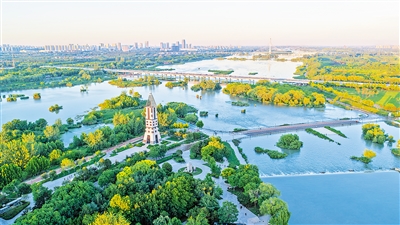 |
| The Hutuo River Ecological Zone in Shijiazhuang city, Hebei province. (PHOTO: XINHUA) |
 |
China has recently released the third batch of innovative and applicable technology catalog for ecological restoration.
The catalog was jointly released by the Ministry of Natural Resources and the National Forestry and Grassland Administration, aiming to empower ecological restoration practices during the 15th Five-Year Plan period (2026-2030) through sci-tech innovation.
A total of 35 technologies were ultimately selected for the catalog, covering 10 major ecological restoration scenarios. The final selection followed a rigorous process involving voluntary application, preliminary evaluation, comprehensive review and public notification.
The selected technologies will be used in forest, grassland, wetland, and desert ecological restoration, marine ecological restoration, aquatic ecological restoration, and mine ecological restoration.
Technologies in degraded land ecological restoration and treatment, invasive alien species control and pest management, ancient and notable trees protection, ecosystem carbon sinks, natural ecological monitoring and evaluation are also included.
The selected technologies have been proven effective through engineering practices, serving as a tailored toolkit for different regions and various types of ecological restoration.
During the 15th Five-Year Plan period, China's ecological restoration will place greater emphasis on systematic governance, precise restoration, synergistic integration and quality and efficiency enhancement.
According to officials from relevant departments, they will focus on innovation in ecological restoration technologies, with a particular emphasis on putting effective technologies into practice, enriching the ecological restoration toolkit, and invigorating collaborative sci-tech innovation.
Announcements will be released to the public to promote their application, guiding localities to prioritize advanced and applicable technologies throughout the entire lifecycle of ecological restoration projects, including design, implementation, acceptance, monitoring and evaluation.
Efforts will be made to continuously solicit and update ecological restoration technologies, dynamically optimize the catalog's contents, and accelerate the formulation of supporting technical standards and norms.
Support will also be provided to encourage R&D in ecological restoration, organizing joint research initiatives to tackle critical technological bottlenecks. Advanced technologies, such as AI, will be harnessed to develop a batch of original and pioneering technologies.