

 Next
Next


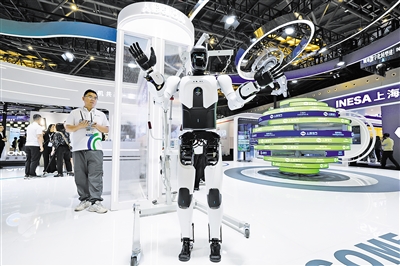 |
| SUYUAN 2.0, an industrial humanoid robot developed by Shanghai Electric. (PHOTO: VCG) |
 |
China has launched a nationwide real-world training initiative for humanoid robots and embodied intelligence, aiming to advance the deployment and application of these technologies.
According to a notice jointly issued by the Ministry of Industry and Information Technology (MIIT) and the State-owned Assets Supervision and Administration Commission of the State Council, China will push for the commercial rollout of 10,000 humanoid robots and over 100 high-value application scenarios by the end of 2026.
China's humanoid robots and embodied intelligence are shifting from laboratory testing to real-world deployment, and from demonstration verification to regular operation, said an official from the MIIT's science and technology department. However, the official noted that bottlenecks remain in areas including model algorithms, hardware performance, scenario adaptability and real-world data accumulation.
Practical real-world training is the key solution to tackling these limitations. Centralized, standardized and shared training venues can eliminate redundant scenario creation and resource waste. This process is essential to transform humanoid robots from just being functional to becoming highly reliable and practical.
The training initiative centers on six key tasks covering industrial, service and special-purpose sectors: constructing real-world training venues, establishing innovation and application institutions, developing practical operational capabilities, advancing real-world application verification and regular deployment, strengthening support for core development enablers, and consolidating proven best practices.
The initiative addresses application demands for humanoid and quadruped robots across core scenarios, such as manufacturing, inspection and analysis, maintenance, warehousing and logistics, catering and retail, medical care and rehabilitation, emergency rescue, and disaster prevention and mitigation.
Dedicated real-world training units will be designated as training venues, with clear functional demands, defined operating conditions, high standardization, and sound economic viability.
Regarding the establishment of innovation and application institutions, the initiative encourages the formation of scenario-specific institutions led by end-users and original equipment manufacturers or application service providers. These institutions should also include supply chain enterprises specializing in model algorithms and components, as well as research institutes.
Additionally, the initiative calls for enhanced data governance, promoting secure and orderly data sharing, while fully ensuring data security, privacy and trade secret protection.