

 Next
Next


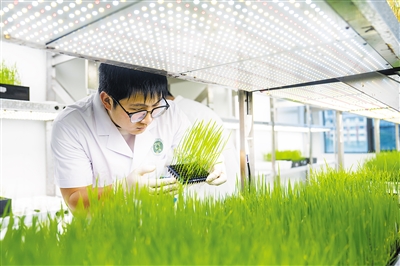 |
| A researcher monitors hybrid rice growth in a smart greenhouse at a national lab in Changsha, Hunan province. (PHOTO: XINHUA) |
Science magazine has reported that in May, several members of the U.S. Congress introduced the Securing Innovation and Research from Adversaries (SIRA) Act, a bill that would prohibit U.S. researchers from using federal funds to collaborate with "blacklisted" Chinese entities. These include Chinese institutions and individuals. Joint research projects, co-authored papers, data sharing, personnel exchanges, and even the co-supervision of students would all be prohibited.
A controversial escalation
The scope and severity of the proposed restrictions are virtually unprecedented in international scientific cooperation since the end of the Cold War.
The legislation is widely seen as a more targeted successor to the controversial Safeguarding American Innovation Act (SAFE Act), which sparked intense debate in 2025. The SAFE Act sought to prohibit U.S. scientists from collaborating with research institutions in countries designated as "foreign adversaries." This proposal immediately triggered opposition from nearly 800 scholars and several Ivy League universities, ultimately forcing lawmakers to remove the provision.
The SIRA Act has met with similar criticism. In a statement to Science, Representative Ro Khanna (CS), the top Democrat on the House Select Committee, warned that, "Overly broad legislation risks chilling legitimate, nonsensitive research and actually harms our ability to outinnovate China." Caroline Wagner, a science policy expert at The Ohio State University, described the bill as "an attempt to intimidate universities" into dropping any existing collaborations with "foreign adversaries" and blocking new ones. The backlash illustrates how controversial and impractical many in the academic community consider the proposal to be.
National security or competitive anxiety?
Measures like the SIRA Act routinely invoke "national security" to justify pushing U.S.-China scientific relations toward "comprehensive decoupling." Yet such efforts reveal a deeper anxiety among some American politicians. As China continues to make breakthroughs in fields such as AI and biomedicine, and as its share of global scientific output has risen dramatically over the past two decades, concerns about maintaining technological leadership have intensified. In this context, "national security" increasingly appears less like a genuine concern and more like a response to growing competition in science and technology.
For the U.S. to maintain its innovation ecosystem, the contributions of Chinese researchers and Chinese-American scientists are indispensable. A 2024 MacroPolo study found that 38 percent of researchers working at leading U.S. AI institutions were educated at Chinese universities, slightly exceeding the 37 percent trained in the United States. Furthermore, in 2020, Chinese students accounted for 17 percent of all U.S. doctoral degrees awarded in science and engineering. These figures reflect the longstanding strength of the American research system to attract global talent. However, proposals such as the SIRA Act threaten to undermine that advantage.
The price of decoupling
The U.S. has been down this road before. In 2018, Washington launched the "China Initiative," a program that severely impacted academic cooperation. As Nature reported, the share of Chinese papers co-authored with U.S. researchers fell by 6.4 percent between its peak in 2017 and 2023 — the largest decline of any country included in the analysis.
Research published in the Proceedings of the National Academy of Sciences (PNAS) found that China has long been the most important partner for the U.S. in the field of life sciences. However, U.S.-China cooperation slowed in 2019, partly due to investigations launched by the National Institutes of Health (NIH) in 2018, targeting scientists involved with Chinese collaborators. The affected U.S. researchers saw a significant decline in research output compared to their peers.
The chilling effect of political pressure is steadily eroding the openness, collaborative advantages and innovative dynamism that the United States spent decades cultivating. A report by the Quincy Institute for Responsible Statecraft noted that U.S.-China scientific cooperation was the fastest-growing and largest bilateral research partnership in the world between 2005 and 2017. However, the relationship reached a turning point around 2017-2018.
The report argues that, "The evidence from the past decade demonstrates that complete disengagement from China is neither feasible nor desirable." The report warns that efforts to sever scientific ties with China could undermine America's innovative edge by "cutting off access and visibility into global scientific frontiers." It warns that severing scientific ties with China could "concede influence over global scientific norms to China, the European Union and other emerging players."
The facts are increasingly clear: comprehensive decoupling is a self-defeating strategy. Efforts intended to slow down another country's progress often end up constraining one's own capacity for innovation. Science is a shared endeavor of humanity. In the face of major challenges such as climate change and public health, no country can stand alone.
Turning academic exchange into a battleground of geopolitical rivalry is a betrayal of the scientific spirit. China has always been open to international cooperation based on equality and mutual benefit — this is not only a commitment to the laws of science, but also a responsibility for the shared future of humanity. Scientific truth belongs to all of humanity, and no one can stop those who seek it.