

 Next
Next


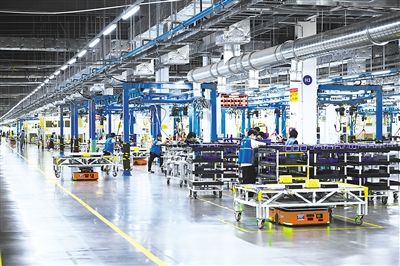 |
| A battery pack production line for new energy vehicles at a technology firm in Hefei, Anhui province. (PHOTO: XINHUA) |
China aims to capitalize on the trends of a new scientific and technological revolution and industrial transformation, to advance its new-type industrialization, according to a State Council executive meeting held on June 5.
During the 14th Five-Year Plan period (2021-2025), China recorded historic achievements in new-type industrialization. By 2025, its manufacturing industry had maintained its position as the world's largest by scale for 16 consecutive years. A host of emerging industries, including new energy vehicles, photovoltaics, shipbuilding and marine engineering equipment have expanded rapidly, and the capacity for independent control of key industrial chains has risen exponentially.
Advancing new industrialization constitutes a long-term strategic task. The meeting put forward requirements to stay committed to the intelligent, green and integrated development pathways, and coordinate the transformation and upgrading of traditional industries, the growth of emerging industries, and forward-looking layout of future industries.
It also highlighted next-generation smart manufacturing as the main focus, urging the project to reconstruct industrial foundations and drive high-quality development of key manufacturing industrial chains. In addition, a call came at the meeting to expand high-standard opening-up and cooperation, while fully implementing the catalogue of encouraged industries for foreign investment.
China's industrial development has shifted from quantitative accumulation to quality improvement, and is now at a pivotal stage of growing from large to strong, according to the Xin Yongfei, head of the Policy and Economic Research Institute at the China Academy of Information and Communications Technology.
"Targeting the goal of basically realizing new-type industrialization by 2035, a series of arrangements introduced at the meeting in the inaugural year of the 15th Five-Year Plan period will further shore up confidence in development and clarify priorities," said Xin.
The meeting proposed a package of arrangements to accelerate the cultivation and growth of future industries, including: stepping up forward-looking planning and promotion to firmly seize the initiative in development; consolidating technological foundations by steadily increasing investment in basic research; prioritizing ecosystem development to foster in-depth integration of industry, academia, research and application; and fully utilize the guiding role of government investment funds.
Wang Peng, associate research fellow of the Institute of Management Studies of the Beijing Academy of Social Sciences, said that while China's cultivation of future industries has maintained sound momentum, challenges such as insufficient original innovation capacity, an imperfect innovation ecosystem, and institutional and mechanism barriers still remain. The measures outlined at the meeting are highly targeted, instructive and operable, offering guidance for coordinated nationwide work and problem-solving.
The meeting also stressed the need to guide rational industrial layout and improve regulation and governance to prevent herd investment and unnecessary construction.
Experts noted that adapting measures to local conditions and highlighting distinctive strengths are crucial methodologies for proactively positioning future industries. Localities should leverage their respective comparative advantages, pursue tailored development strategies, and continuously drive industrial growth through innovation.