

 Next
Next


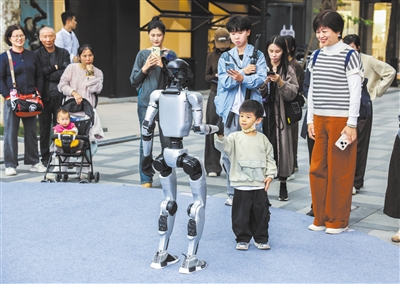 |
| A boy interacts with a humanoid robot in Puyuan Fashion Resort, Jiaxing, east China's Zhejiang province. (PHOTO: XINHUA) |
Jiaxing, a city renowned as a manufacturing hub, has long relied on pillar industries like textiles, leather and hardware to drive its economic development. However, in recent years, the city has embraced advanced manufacturing clusters, using AI to accelerate upgrading of its traditional industries while simultaneously growing emerging and future industries.
At present, Jiaxing's AI industry records an annual revenue of 76.77 billion RMB, ranking third in Zhejiang province. Its deployed computing power stands at approximately 85,000 PFLOPS, accounting for half of Zhejiang's total.
CSB Bearing Technologies Co., Ltd., a manufacturer specializing in self-lubricating bearings, began researching and developing sliding bearings and joint bearings for robots in 2023. Adopting polymer composite materials, the manufacturer has successfully developed innovative products that operate stably in extreme environments ranging from -40°C to 120°C, with wear life more than three times the international standard. Its humanoid robot joint bearings have now entered the supply chains of several leading robotics enterprises.
Faced with the development bottlenecks of the traditional paper products industry — low added value, low user loyalty and insufficient data assets — Jiaxing Kexinrou Paper Industry, the country's top online seller in the wet tissue category, leverages AI technology to analyze consumer behavior and short-video content. It accurately identified the demands of core groups such as "refined mothers" and "rhinitis sufferers," realizing a digital-driven transformation to smart manufacturing.
In the traditional steel plate cutting sector, a company adopts an "AI+ Collaborative Manufacturing" model, connecting more than 10,000 large CNC cutting devices, over 1,400 registered users and more than 60 suppliers across the country onto a unified online platform. The system can automatically interpret engineering drawings, apply AI-based pricing, and conduct intelligent order dispatching, helping enterprises raise material utilization by over 10 percent.
Meanwhile, AI is also reshaping the design workflow of the traditional apparel industry. By integrating independently developed AI software, designers at Shenfu Technology have increased their average daily output from three to four styles to 400-500 and shortened the lead time from design to sample delivery to just 72 hours per order.
While revitalizing traditional industries, Jiaxing has made forward-looking layouts for future industries, pinpointing three core directions: AI, life sciences and health, and future energy.
At the industrial embodied intelligence training center of Institute of Flexible Electronics Technology of Tsinghua University, Zhejiang, various robots conduct scenario training and data collection via flexible tactile sensors. Currently, 240 robots are in training at the center.
It is reported that the center will complete the construction of a data collection platform and industrial demonstration lines this year, achieving 600,000 hours of data collection annually. It targets a data capacity of 1.5 million hours by 2027, and plans to build a national high-quality industrial embodied intelligence dataset and launch the world's first fully autonomous robot operation production line by 2028.
Moreover, Jiaxing has established a tiered cultivation system for R&D institutions, covering municipal high-tech R&D centers, provincial enterprise research institutes, provincial key enterprise research institutes, and global R&D centers.
Among industrial enterprises above designated size in the city, 5,065 have set up internal R&D institutions, with a coverage rate of 74.3 percent — ranking first in Zhejiang for five consecutive years, said Zhou Xiaojun, deputy director of Jiaxing Municipal Bureau of Science and Technology.
Local officials have announced plans to further improve the city's large-scale investment system for scientific and technological innovation. They also aim to accelerate the development of a new computing power system, and build a 10,000-GPU-scale high-performance computing cluster in the Yangtze River Delta.