


 |
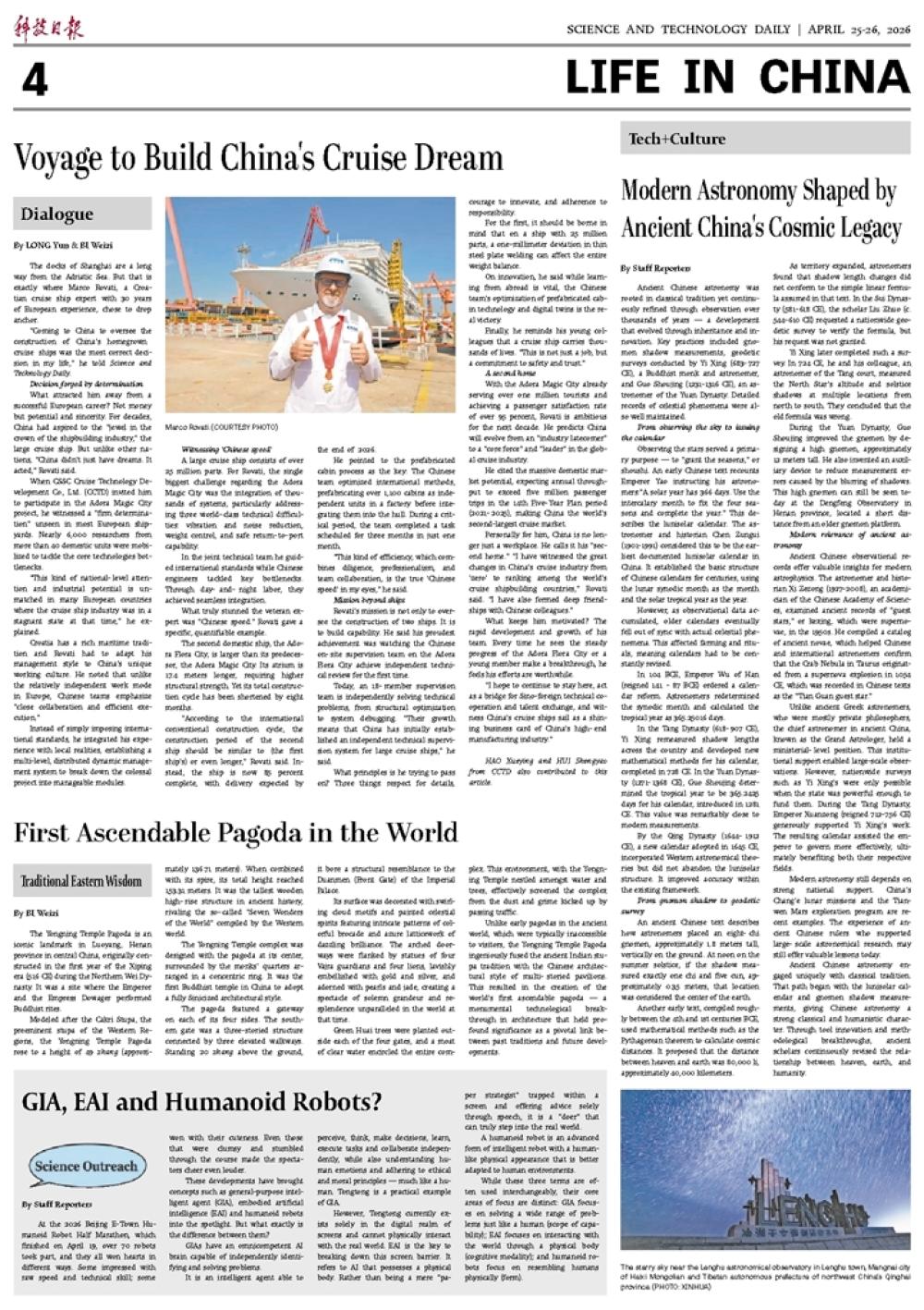
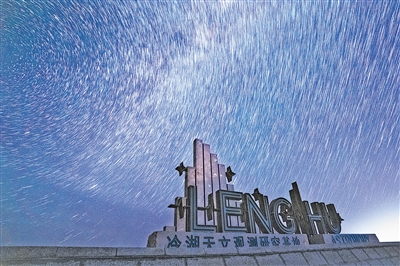
| The starry sky near the Lenghu astronomical observatory in Lenghu town, Mangnai city of Haixi Mongolian and Tibetan autonomous prefecture of northwest China's Qinghai province. (PHOTO: XINHUA) |
Ancient Chinese astronomy was rooted in classical tradition yet continuously refined through observation over thousands of years — a development that evolved through inheritance and innovation. Key practices included gnomon shadow measurements, geodetic surveys conducted by Yi Xing (683-727 CE), a Buddhist monk and astronomer, and Guo Shoujing (1231-1316 CE), an astronomer of the Yuan Dynasty. Detailed records of celestial phenomena were also well maintained.
From observing the sky to issuing the calendar
Observing the stars served a primary purpose — to "grant the seasons," or shoushi. An early Chinese text recounts Emperor Yao instructing his astronomers:"A solar year has 366 days. Use the intercalary month to fix the four seasons and complete the year." This describes the lunisolar calendar. The astronomer and historian Chen Zungui (1901-1991) considered this to be the earliest documented lunisolar calendar in China. It established the basic structure of Chinese calendars for centuries, using the lunar synodic month as the month and the solar tropical year as the year.
However, as observational data accumulated, older calendars eventually fell out of sync with actual celestial phenomena. This affected farming and rituals, meaning calendars had to be constantly revised.
In 104 BCE, Emperor Wu of Han (reigned 141–87 BCE) ordered a calendar reform. Astronomers redetermined the synodic month and calculated the tropical year as 365.25016 days.
In the Tang Dynasty (618-907 CE), Yi Xing remeasured shadow lengths across the country and developed new mathematical methods for his calendar, completed in 728 CE. In the Yuan Dynasty (1271-1368 CE), Guo Shoujing determined the tropical year to be 365.2425 days for his calendar, introduced in 1281 CE. This value was remarkably close to modern measurements.
By the Qing Dynasty (1644-1912 CE), a new calendar adopted in 1645 CE, incorporated Western astronomical theories but did not abandon the lunisolar structure. It improved accuracy within the existing framework.
From gnomon shadow to geodetic survey
An ancient Chinese text describes how astronomers placed an eight-chi gnomon, approximately 1.8 meters tall, vertically on the ground. At noon on the summer solstice, if the shadow measured exactly one chi and five cun, approximately 0.35 meters, that location was considered the center of the earth.
Another early text, compiled roughly between the 4th and 1st centuries BCE, used mathematical methods such as the Pythagorean theorem to calculate cosmic distances. It proposed that the distance between heaven and earth was 80,000 li, approximately 40,000 kilometers.
As territory expanded, astronomers found that shadow length changes did not conform to the simple linear formula assumed in that text. In the Sui Dynasty (581-618 CE), the scholar Liu Zhuo (c. 544-610 CE) requested a nationwide geodetic survey to verify the formula, but his request was not granted.
Yi Xing later completed such a survey. In 724 CE, he and his colleague, an astronomer of the Tang court, measured the North Star's altitude and solstice shadows at multiple locations from north to south. They concluded that the old formula was wrong.
During the Yuan Dynasty, Guo Shoujing improved the gnomon by designing a high gnomon, approximately 12 meters tall. He also invented an auxiliary device to reduce measurement errors caused by the blurring of shadows. This high gnomon can still be seen today at the Dengfeng Observatory in Henan province, located a short distance from an older gnomon platform.
Modern relevance of ancient astronomy
Ancient Chinese observational records offer valuable insights for modern astrophysics. The astronomer and historian Xi Zezong (1927-2008), an academician of the Chinese Academy of Sciences, examined ancient records of "guest stars," or kexing, which were supernovae, in the 1950s. He compiled a catalog of ancient novae, which helped Chinese and international astronomers confirm that the Crab Nebula in Taurus originated from a supernova explosion in 1054 CE, which was recorded in Chinese texts as the "Tian Guan guest star."
Unlike ancient Greek astronomers, who were mostly private philosophers, the chief astronomer in ancient China, known as the Grand Astrologer, held a ministerial-level position. This institutional support enabled large-scale observations. However, nationwide surveys such as Yi Xing's were only possible when the state was powerful enough to fund them. During the Tang Dynasty, Emperor Xuanzong (reigned 712-756 CE) generously supported Yi Xing's work. The resulting calendar assisted the emperor to govern more effectively, ultimately benefiting both their respective fields.
Modern astronomy still depends on strong national support. China's Chang'e lunar missions and the Tianwen Mars exploration program are recent examples. The experience of ancient Chinese rulers who supported large-scale astronomical research may still offer valuable lessons today.
Ancient Chinese astronomy engaged uniquely with classical tradition. That path began with the lunisolar calendar and gnomon shadow measurements, giving Chinese astronomy a strong classical and humanistic character. Through tool innovation and methodological breakthroughs, ancient scholars continuously revised the relationship between heaven, earth, and humanity.