

 Next
Next


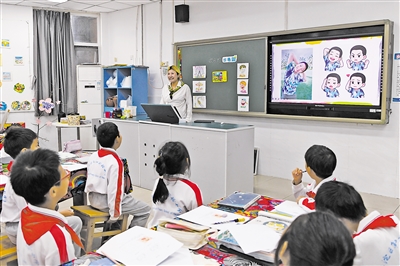 |
| A teacher shows cartoon images of students generated by AI technology. (PHOTO: XINHUA) |
 |
In its latest efforts to become an education powerhouse, China has launched an AI+education action plan.
The plan was jointly released by five government bodies, including the Ministry of Education, the National Development and Reform Commission, and the Ministry of Science and Technology.
By 2030, a framework for the deep integration of AI and education will be basically established. A comprehensive AI education system covering all stages of education and a general education system for the entire society — characterized by vertical continuity and horizontal connectivity — will be built.
The scale and quality of AI talent cultivation will be significantly improved, and a long-term mechanism for nurturing AI literacy will be formed.
Systemic transformation will be achieved in educational and teaching models, scientific research paradigms, and governance modes.
The capacity for education service supply and the level of modernization will be substantially elevated.
The foundational support environment will become more intensive and efficient, while the innovation ecosystem will grow more open and collaborative.
The application of intelligent technologies will become more inclusive, secure, and efficient, cultivating a batch of high-value, scalable, and replicable application scenarios.
A new form of smart education will take shape, with its global influence reaching the forefront.
To achieve such goals, efforts will be made to speed up the rollout of AI education in primary and secondary schools, citing measures such as integrating AI education into local curriculum systems, encouraging cross-disciplinary AI teaching, and building AI education bases.
Efforts will also be made to cultivate high-level talent tailored for the intelligent era, pushing for establishing AI as a basic public course in universities and developing specialized textbooks categorized by academic disciplines.
It urges efforts to accelerate the upgrading and transformation of traditional disciplines in vocational education, advance public AI awareness and literacy initiatives, and improve the AI competencies and pedagogical skills of educators across all levels.
The plan calls for leveraging AI to empower learning, teaching, educational governance, and scientific research.
It also highlights advancing research and innovation in AI+education, strengthening the enabling conditions and support systems for AI+education, and promoting international cooperation in AI+education.