


 |
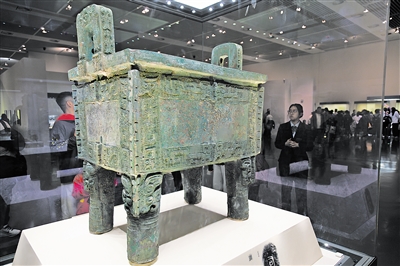
| The photo shows the Houmuwu Ding (also known as Simuwu Ding). The bronze cauldron was cast using nearly 100 clay piece molds and integrating composite mold techniques, separate casting, precision mold joining, large-scale smelting and other technologies. (PHOTO: VCG) |
The development of ancient Chinese metallurgy stands as an important achievement in human civilization. It was a systematic process marked by a high degree of independent innovation, deeply intertwined with the social structure and intellectual culture of its time.
Although the earliest copper and iron smelting techniques did not originate in the lands that would become China, Chinese artisans eventually surpassed others through a series of original technological breakthroughs. From the piece-mold casting of the Bronze Age to the invention of pig iron smelting in the Iron Age, these innovations boosted productivity and provided the essential material foundation and technical support for the formation of early Chinese states and the construction of the ritual system.
Piece-mold casting
The rise of China's Bronze Age marked the maturation of an independent and highly sophisticated technological system. Unlike early copper artisans in West Asia and the Mediterranean region, who primarily used lost-wax casting or forging, craftsmen in ancient China, beginning in the period of Erlitou culture (a Bronze Age culture in the Yellow River valley from approximately 1900 BCE to 1500 BCE), pioneered and developed the technique of piece-mold casting. This foundational method set the course for subsequent bronze production and even metalworking in China.
In essence, piece-mold casting uses multiple pre-made inner and outer molds to form a cavity into which molten metal is poured in a single operation. This process demanded a high level of systematic planning and precise process control.
The Houmuwu Ding from the late Shang Dynasty (1600 BCE-1046 BCE), a massive rectangular sacrificial vessel famed as the heaviest known ancient bronze artifact in the world, is a prime example.
Its casting required nearly 100 individual ceramic molds and integrated various technical elements, including composite clay molds, sectional casting, precise mold assembly, large-scale smelting and pouring, and scientific alloy ratios. These technical steps were tightly interlinked, forming a complex and meticulous engineering system.
Precisely because piece-mold casting enabled the mass production of bronze vessels with complex shapes, standardized forms, and intricate decorative patterns, bronze objects were able to transcend their purely practical functions to become the ultimate symbols of the ritual and musical systems. The innovation in metallurgical technology thus became the crucial material medium through which "ritual civilization" was established and expressed.
Achieving breakthroughs
Another landmark contribution of ancient Chinese metallurgy to human civilization was the invention and large-scale application of pig iron smelting. For a long period, the rest of the world primarily relied on the bloomery process, which reduced iron ore in a solid state to produce a spongy mass of wrought iron.
This method was inefficient and did not allow direct casting. In contrast, China had mastered the liquid smelting of pig iron through a series of technological innovations by the late Spring and Autumn Period (770 BCE-476 BCE) at the latest.
The key to this breakthrough was the advancement of bellows technology and the iron-smelting furnace. By raising the height of the shaft furnace, intensifying the air blast, and using fluxes, craftsmen were able to raise the internal temperature sufficiently to melt the iron ore, producing liquid pig iron that could be cast directly into shape.
The production efficiency of liquid pig iron smelting far surpassed that of the bloomery process. It also allowed for the casting of complex implements, including durable iron molds, which enabled the self-reinforcing crafting of production tools.
Although pig iron was highly hard, its brittleness limited the range of its direct applications. To resolve this problem, Chinese craftsmen from the Warring States Period (475 BCE-221 BCE) to the Han Dynasty (202 BCE-220 CE) developed a comprehensive set of subsequent processing and reprocessing techniques, forming a complete iron and steel technological system.
Annealing involved subjecting cast iron objects to prolonged heat treatment to "soften" them, producing malleable cast iron with significantly improved strength and toughness. Puddling involved heating pig iron to a semi-molten state and stirring it in the air to decarburize it into steel or wrought iron.
The co-fusion process took advantage of the high carbon content of pig iron and the low carbon content of wrought iron by smelting them together, allowing the carbon from the pig iron to evenly diffuse into the wrought iron, thereby efficiently obtaining high-quality steel.
These technological innovations gave rise to a unique and distinct system of iron and steel technology in ancient China, enabling the country to lead the world in both the quantity and quality of iron and steel production for a considerable period. Iron and steel were thus widely applied in the manufacture of agricultural tools, implements, and weapons, greatly boosting agricultural productivity and advancing military technology, providing a solid material foundation for the economic development of ancient Chinese society.
This is edited and translated from the article written by Qian Wei, dean and professor of the Institute for Cultural Heritage and History of Science & Technology, University of Science and Technology Beijing.