
 Next
Next


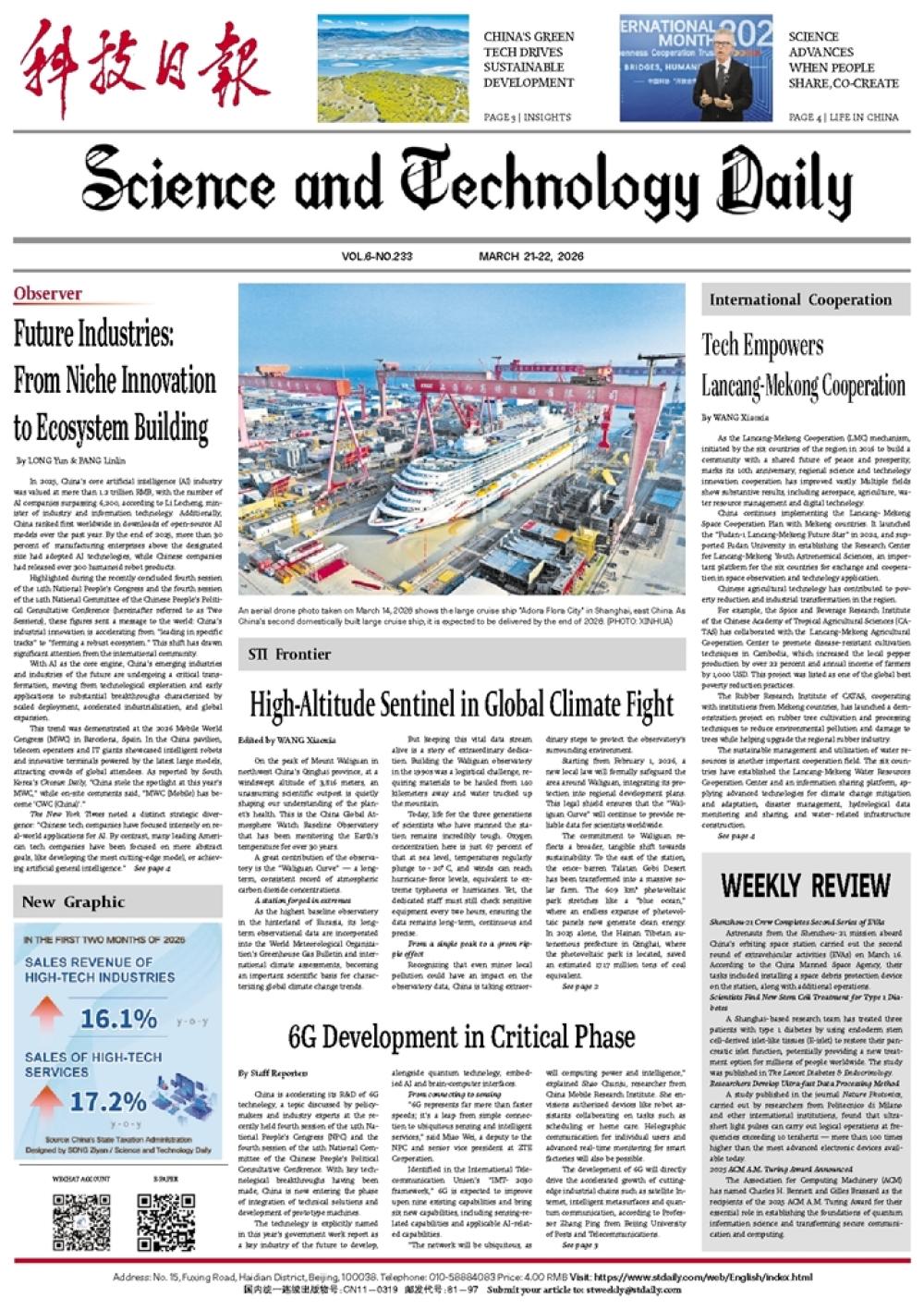
In 2025, China's core artificial intelligence (AI) industry was valued at more than 1.2 trillion RMB, with the number of AI companies surpassing 6,200, according to Li Lecheng, minister of industry and information technology. Additionally, China ranked first worldwide in downloads of open-source AI models over the past year. By the end of 2025, more than 30 percent of manufacturing enterprises above the designated size had adopted AI technologies, while Chinese companies had released over 300 humanoid robot products.
Highlighted during the recently concluded fourth session of the 14th National People's Congress and the fourth session of the 14th National Committee of the Chinese People's Political Consultative Conference (hereinafter referred to as Two Sessions), these figures sent a message to the world: China's industrial innovation is accelerating from "leading in specific tracks" to "forming a robust ecosystem." This shift has drawn significant attention from the international community.
With AI as the core engine, China's emerging industries and industries of the future are undergoing a critical transformation, moving from technological exploration and early applications to substantial breakthroughs characterized by scaled deployment, accelerated industrialization, and global expansion.
This trend was demonstrated at the 2026 Mobile World Congress (MWC) in Barcelona, Spain. In the China pavilion, telecom operators and IT giants showcased intelligent robots and innovative terminals powered by the latest large models, attracting crowds of global attendees. As reported by South Korea's Chosun Daily, "China stole the spotlight at this year's MWC," while on-site comments said, "MWC (Mobile) has become 'CWC (China)'."
The New York Times noted a distinct strategic divergence: "Chinese tech companies have focused intensely on real-world applications for AI. By contrast, many leading American tech companies have been focused on more abstract goals, like developing the most cutting-edge model, or achieving artificial general intelligence."
The report added that since most of China's leading AI models are free to use, Chinese consumers are directly feeling the benefits of AI.
Indeed, openness has become a defining feature of China's AI development model. This approach has accelerated technology diffusion, allowing AI advancements to benefit a broader range of industries.
The Two Sessions served as a crucial window for the world to observe China's strategic direction for the next five years and beyond.
Foreign experts interviewed by Science and Technology Daily emphasized that China's strategic layout of industries of the future, such as quantum technology and bio-manufacturing, precisely targets the core breakthrough directions of the global technological revolution.
"China's industries of the future do not emerge in isolation but are rooted in its industrial system, the most comprehensive and largest in the world," said Francesco Faiola, an Italian scientist. He described China's approach as "gradual industrial cultivation," a development path grounded in objective conditions.
Dennis Simon, a senior fellow at the Quincy Institute for Responsible Statecraft in the U.S., said that China's unique institutional advantages translate into powerful organizational and mobilization capabilities. He observed that under national policies, China's model of technological and industrial innovation demonstrates higher system integration efficiency than international peers, thanks to its ability to rapidly scale complex engineering systems.
It is precisely this institutional guarantee and effective pathway that enable Chinese technological achievements to spill over globally. This proven model of organizing complex engineering projects holds potential for broader "replication" and "promotion" worldwide.
China's nurturing of emerging industries and industries of the future is currently at a stage where rapid technological evolution runs parallel to the maturation of commercial ecosystems. Equipped with core emerging technologies, Chinese enterprises are riding the waves, striving for "technology export" and "brand globalization."
Recently, Alibaba Cloud has reinforced its global presence with its Agentic AI Development Platform, offering private deployment solutions for international enterprises. Meanwhile, humanoid robot manufacturer Zhiyuan (AGIBOT) has secured a landmark strategic partnership with Singaporean telecom enterprise Singtel Enterprise to launch robot leasing services in Singapore, and is actively expanding its reach through collaborations with key automation integrators such as RH BOTS in Spain.
In 2026, China's tech industry, poised as a frontrunner, is ready to join hands with like-minded partners worldwide to embrace the next wave of technological revolution.