


 |
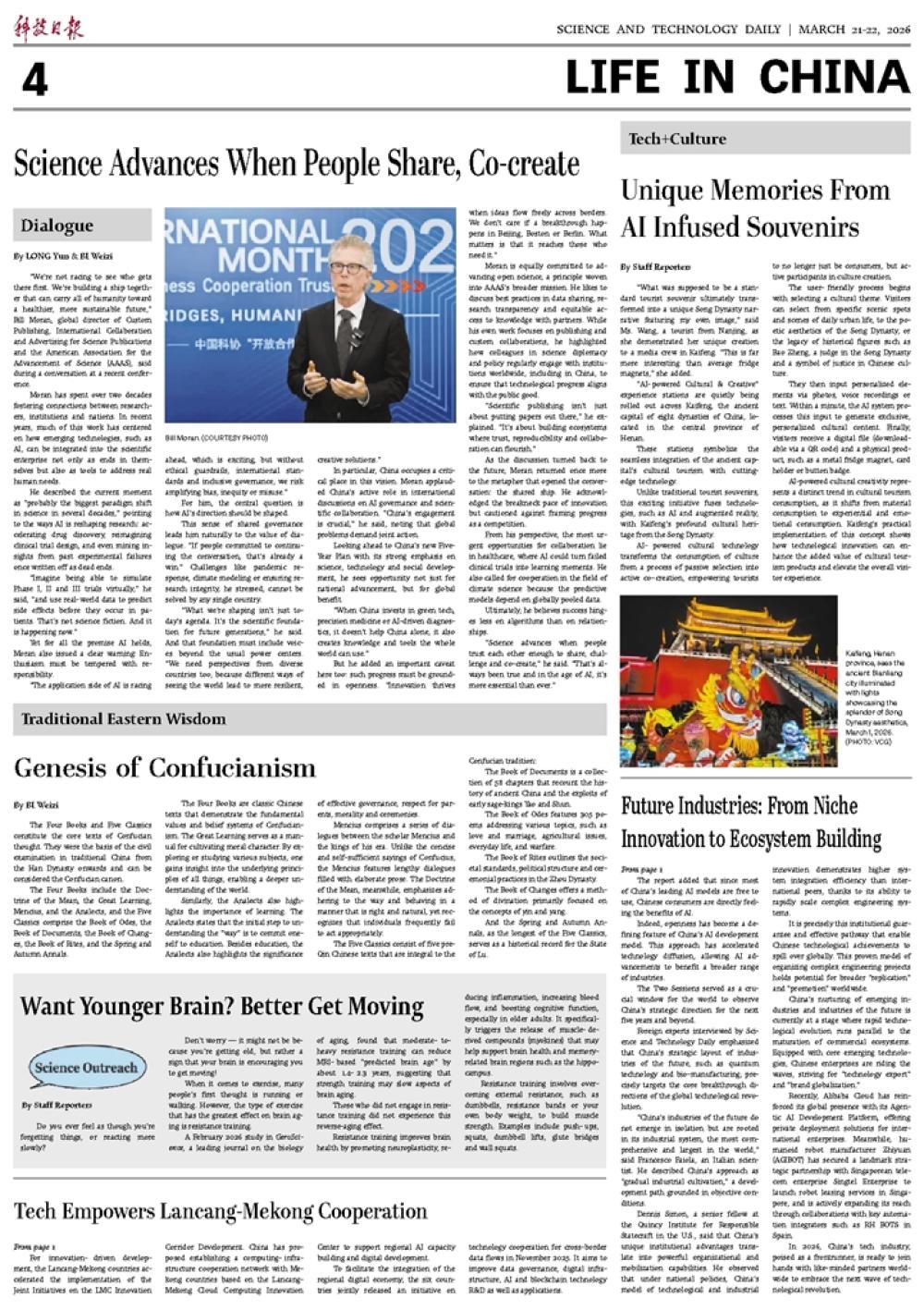
| Bill Moran. (COURTESY PHOTO) |
"We're not racing to see who gets there first. We're building a ship together that can carry all of humanity toward a healthier, more sustainable future," Bill Moran, global director of Custom Publishing, International Collaboration and Advertising for Science Publications and the American Association for the Advancement of Science (AAAS), said during a conversation at a recent conference.
Moran has spent over two decades fostering connections between researchers, institutions and nations. In recent years, much of this work has centered on how emerging technologies, such as AI, can be integrated into the scientific enterprise not only as ends in themselves but also as tools to address real human needs.
He described the current moment as "probably the biggest paradigm shift in science in several decades," pointing to the ways AI is reshaping research: accelerating drug discovery, reimagining clinical trial design, and even mining insights from past experimental failures once written off as dead ends.
"Imagine being able to simulate Phase I, II and III trials virtually," he said, "and use real-world data to predict side effects before they occur in patients. That's not science fiction. And it is happening now."
Yet for all the promise AI holds, Moran also issued a clear warning: Enthusiasm must be tempered with responsibility.
"The application side of AI is racing ahead, which is exciting, but without ethical guardrails, international standards and inclusive governance, we risk amplifying bias, inequity or misuse."
For him, the central question is how AI's direction should be shaped.
This sense of shared governance leads him naturally to the value of dialogue. "If people committed to continuing the conversation, that's already a win." Challenges like pandemic response, climate modeling or ensuring research integrity, he stressed, cannot be solved by any single country.
"What we're shaping isn't just today's agenda. It's the scientific foundation for future generations," he said. And that foundation must include voices beyond the usual power centers. "We need perspectives from diverse countries too, because different ways of seeing the world lead to more resilient, creative solutions."
In particular, China occupies a critical place in this vision. Moran applauded China's active role in international discussions on AI governance and scientific collaboration. "China's engagement is crucial," he said, noting that global problems demand joint action.
Looking ahead to China's new Five-Year Plan with its strong emphasis on science, technology and social development, he sees opportunity not just for national advancement, but for global benefit.
"When China invests in green tech, precision medicine or AI-driven diagnostics, it doesn't help China alone, it also creates knowledge and tools the whole world can use."
But he added an important caveat here too: such progress must be grounded in openness. "Innovation thrives when ideas flow freely across borders. We don't care if a breakthrough happens in Beijing, Boston or Berlin. What matters is that it reaches those who need it."
Moran is equally committed to advancing open science, a principle woven into AAAS's broader mission. He likes to discuss best practices in data sharing, research transparency and equitable access to knowledge with partners. While his own work focuses on publishing and custom collaborations, he highlighted how colleagues in science diplomacy and policy regularly engage with institutions worldwide, including in China, to ensure that technological progress aligns with the public good.
"Scientific publishing isn't just about putting papers out there," he explained. "It's about building ecosystems where trust, reproducibility and collaboration can flourish."
As the discussion turned back to the future, Moran returned once more to the metaphor that opened the conversation: the shared ship. He acknowledged the breakneck pace of innovation but cautioned against framing progress as a competition.
From his perspective, the most urgent opportunities for collaboration lie in healthcare, where AI could turn failed clinical trials into learning moments. He also called for cooperation in the field of climate science because the predictive models depend on globally pooled data.
Ultimately, he believes success hinges less on algorithms than on relationships.
"Science advances when people trust each other enough to share, challenge and co-create," he said. "That's always been true and in the age of AI, it's more essential than ever."