


 |
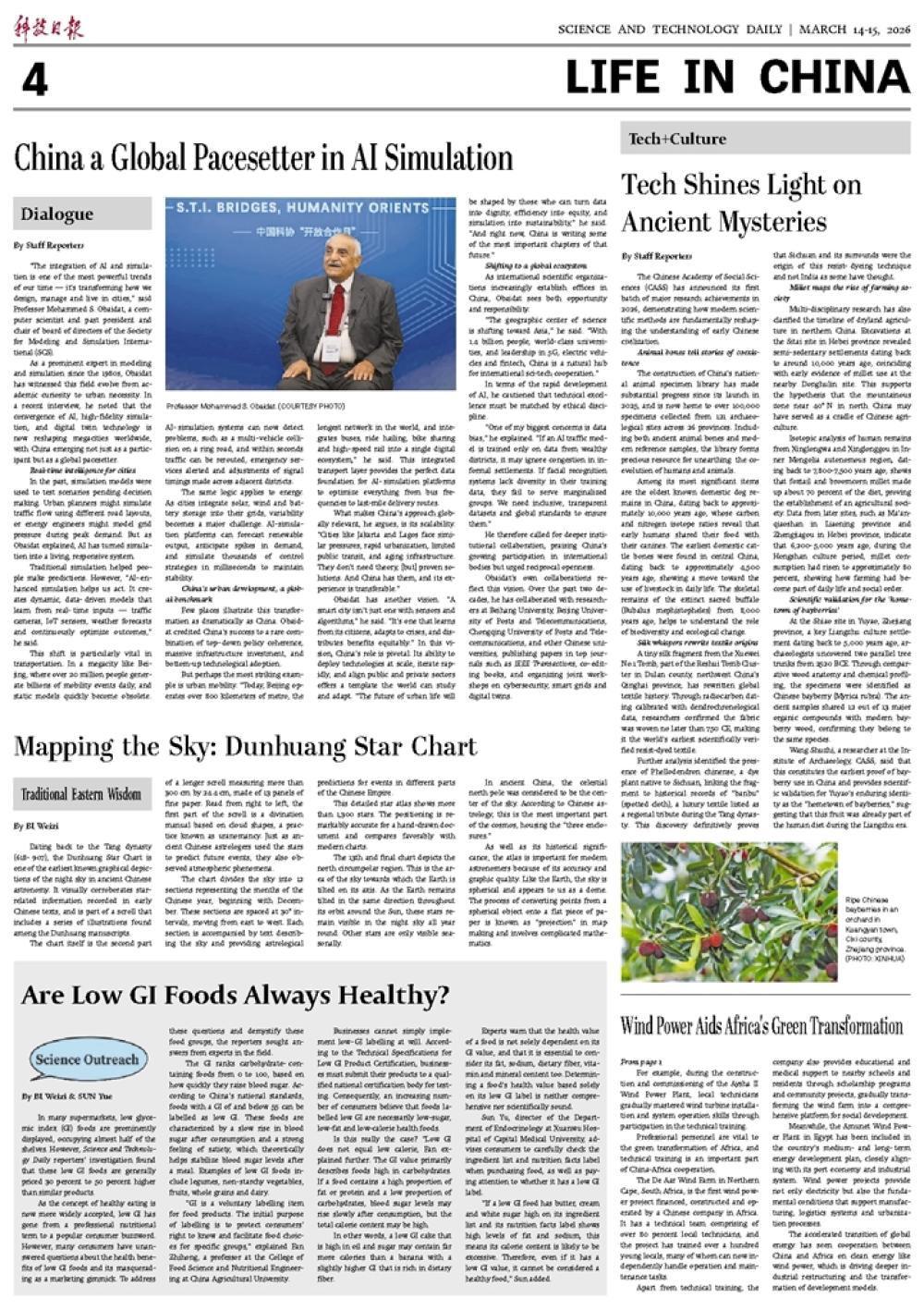
| Ripe Chinese bayberries in an orchard in Kuangyan town, Cixi county, Zhejiang province. (PHOTO: XINHUA) |
The Chinese Academy of Social Sciences (CASS) has announced its first batch of major research achievements in 2026, demonstrating how modern scientific methods are fundamentally reshaping the understanding of early Chinese civilization.
Animal bones tell stories of coexistence
The construction of China's national animal specimen library has made substantial progress since its launch in 2025, and is now home to over 100,000 specimens collected from 121 archaeological sites across 26 provinces. Including both ancient animal bones and modern reference samples, the library forms precious resource for unearthing the co-evolution of humans and animals.
Among its most significant items are the oldest known domestic dog remains in China, dating back to approximately 10,000 years ago, whose carbon and nitrogen isotope ratios reveal that early humans shared their food with their canines. The earliest domestic cattle bones were found in central China, dating back to approximately 4,500 years ago, showing a move toward the use of livestock in daily life. The skeletal remains of the extinct sacred buffalo (Bubalus mephistopheles) from 8,000 years ago, helps to understand the role of biodiversity and ecological change.
Silk whispers rewrite textile origins
A tiny silk fragment from the Xuewei No.1 Tomb, part of the Reshui Tomb Cluster in Dulan county, northwest China's Qinghai province, has rewritten global textile history. Through radiocarbon dating calibrated with dendrochronological data, researchers confirmed the fabric was woven no later than 750 CE, making it the world's earliest scientifically verified resist-dyed textile.
Further analysis identified the presence of Phellodendron chinense, a dye plant native to Sichuan, linking the fragment to historical records of "banbu" (spotted cloth), a luxury textile listed as a regional tribute during the Tang dynasty. This discovery definitively proves that Sichuan and its surrounds were the origin of this resist-dyeing technique and not India as some have thought.
Millet maps the rise of farming society
Multi-disciplinary research has also clarified the timeline of dryland agriculture in northern China. Excavations at the Sitai site in Hebei province revealed semi-sedentary settlements dating back to around 10,000 years ago, coinciding with early evidence of millet use at the nearby Donghulin site. This supports the hypothesis that the mountainous zone near 40°N in north China may have served as a cradle of Chinese agriculture.
Isotopic analysis of human remains from Xinglongwa and Xinglonggou in Inner Mongolia autonomous region, dating back to 7,800-7,500 years ago, shows that foxtail and broomcorn millet made up about 70 percent of the diet, proving the establishment of an agricultural society. Data from later sites, such as Ma'anqiaoshan in Liaoning province and Zhengjiagou in Hebei province, indicate that 6,200-5,000 years ago, during the Hongshan culture period, millet consumption had risen to approximately 80 percent, showing how farming had become part of daily life and social order.
Scientific validation for the 'hometown of bayberries'
At the Shiao site in Yuyao, Zhejiang province, a key Liangzhu culture settlement dating back to 5,000 years ago, archaeologists uncovered two parallel tree trunks from 2520 BCE. Through comparative wood anatomy and chemical profiling, the specimens were identified as Chinese bayberry (Myrica rubra). The ancient samples shared 12 out of 13 major organic compounds with modern bayberry wood, confirming they belong to the same species.
Wang Shuzhi, a researcher at the Institute of Archaeology, CASS, said that this constitutes the earliest proof of bayberry use in China and provides scientific validation for Yuyao's enduring identity as the "hometown of bayberries," suggesting that this fruit was already part of the human diet during the Liangzhu era.