
 Next
Next


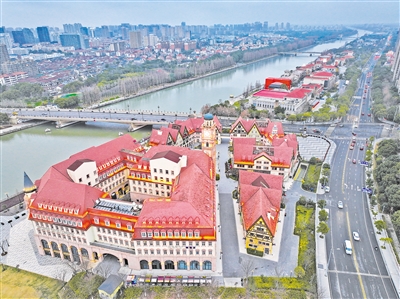 |
| The Rothenburg Style Street in Taicang, Jiangsu province in east China. (PHOTO: XINHUA) |
Taicang, a county-level city in Jiangsu province in east China, just 50 kilometers from Shanghai, is widely known as the hometown of German enterprises in China.
Since welcoming its first German investor in 1993, the city has attracted more than 560 German companies, including over 60 "hidden champions" — small but highly successful companies that excel in their niche but are not well-known to the general public — and several leading manufacturers.
Its rise as one of China's most concentrated hubs for German investment reflects sustained efforts to improve the business climate and integrate more deeply into global industrial supply chains.
How it started
Taicang's journey began in 1993.
With German automaker Volkswagen Group setting up its plant in Shanghai, Kern Liebers, a supplier of automobile seat belt spring, wanted to invest in China too. It finally chose Taicang for its proximity to Shanghai, convenient transport, rich culture and skilled workforce.
Kern Liebers started with a 400-square-meter factory, a modest beginning that marked the start of a long partnership between the city and German industry.
By 2000, more than 10 German enterprises had arrived. The number reached 100 by 2007, and surpassed 500 by 2024.
Taicang's investment environment, efficient local administration and strong industrial support have helped create a clustering effect: One company arrives, others follow, then a cluster forms.
For German enterprises, Taicang is not simply a factory location, but a base for long-term development.
Today Kern Liebers has grown into an industry leader with an annual output exceeding 1.5 billion RMB. Its trajectory mirrors that of many German businesses in the city.
Taicang now hosts nearly 10 percent of all German manufacturing enterprises in China. More than 90 percent of the early German investors have expanded their operations.
Fertile soil for German firms
Why has Taicang become the second hometown for so many German enterprises? The answer lies in the high-quality industrial ecosystem this city has cultivated.
Taicang has developed three German-led industrial clusters: automotive components, high-end equipment, and new energy, supported by over a thousand supply chain companies.
Yang Xinhua, general manager of Huber Ranner Environment Equipment Taicang Co., Ltd., said the company has added investment and expanded production three times in Taicang.
"We can find 90 percent of our suppliers within a 10-kilometer radius," he said. This reduces logistics costs and duration, while providing certainty and stability.
In December 2025, Beumer Enterprise Management (Taicang) Company, a leading intralogistics systems manufacturer, opened its new workshop. The project took just 115 days from signing to construction.
Huang Xiaohua, CFO of Beumer China, said the local government team provided a schedule down to half-day tasks, praising the precision of local planning as aligned with German business practices.
From a single factory in 1993 to a dense network of German industrial leaders today, Taicang's evolution reflects more than local development. It illustrates how sustained policy support, industrial clustering and cross-border trust can shape long-term international partnerships.
Local officials said Taicang will align more closely with the national strategy during the 15th Five-Year Plan period (2026-2030) and deepen cooperation with German industry.