

 |
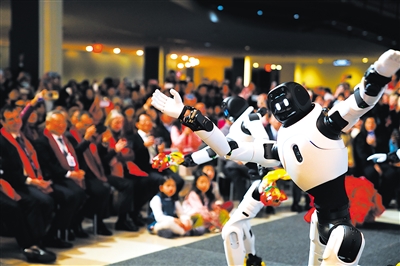
| Humanoid robots dance at the Chinese New Year gala at the UN headquarters in New York. (PHOTO: XINHUA) |
The celebrations across China at the start of the New Year of the Horse showcased a festival that honored ancient customs while embracing modern innovation and welcoming the world.
From the tropical shores of Hainan in south China to Beijing's historical temple fairs, this Spring Festival demonstrated how the Chinese New Year continues to evolve while maintaining its cultural core of family reunion and harmony.
Traditional customs meet modern flair
Liakhova Albina, a Russian social media influencer based in Hainan, decorated her apartment with traditional couplets on paper, shopped for festive goods, and prepared a grand reunion dinner.
She shared these experiences online, introducing her international followers to Chinese traditions.
"This Spring Festival, I felt warmth that crosses borders," she said and her sentiment echoed across the country.
Celebrations have become creative nationwide. The China-chic market at Journey to the West Paradise in Huai'an, Jiangsu province in east China, a theme park dedicated to the classic Chinese novel Journey to the West, was an illuminating example of that. So was water town Wuzhen's popular tech-powered light show in Zhejiang province, also in east China.
The horse zodiac has inspired a wave of cultural and creative products. In Gansu province in the northwest, artisans made embroidered horse paintings, seal carvings, and cloisonné ornaments based on local horse culture.
"The zodiac culture is an important carrier connecting public emotions," said Diao Jinuo, vice dean of the Culture and Tourism Integration Innovation Research Institute at the Communication University of China. "The popularity of Horse Year products reflects the maturing of festival derivative markets."
Technology enhances festival experience
Technology has added new dimensions to traditional celebrations. In Xiamen, Fujian in southeast China, a digital intangible cultural heritage event along the century-old Qilou arcade regaled visitors with overseas Chinese remittance history, lacquer line carving, and Gezai opera through AR and VR technologies.
A "human-robot dance" performance streamed online to over 100,000 viewers.
"We add technological elements to intangible heritage to innovate the presentation and inheritance of traditional culture," said Lin Gonghua from Zhixing Mozuo Artificial Intelligence Technology Co.
Humanoid robots appeared in multiple Spring Festival celebrations, including the CMG Spring Festival Gala.
Technology has empowered cultural tourism: Beijing's Haidian Science Temple Fair featured robot storytellers; thousands of drones painted horse images in the night sky over the majestic Hengshan Mountain in Hunan in central China, while the Shanghai Science and Technology Museum collaborated with the Palace Museum in Beijing to produce a Horse Year exhibition using naked-eye 3D and AI.
Many people used AI to create personalized couplets, custom greeting videos, and even digitally include departed loved ones in family photos.
Chinese New Year goes global
International interest in experiencing the Chinese New Year firsthand continues to grow. Renata, a Mexican visitor, traveled to Beijing with her family during the holiday. At a traditional courtyard house, she tried making dumplings, writing "fu" or good luck characters, and creating a sugar-painting horse after learning she was born in a year of the horse.
"The charm of Chinese New Year lies in different meaningful activities each day, completed together with family — joyful and warm," Renata said.
As a super intellectual property of Chinese culture, the Spring Festival is boosting China's appeal as a global tourism destination. According to the National Immigration Administration, optimized visa-free policies and consumption stimulus measures are expected to drive bidirectional growth in outbound and inbound tourism, with daily border crossings exceeding 2.05 million passengers, up 14.1 percent from last year.
In 2024, "Spring Festival — Social Practice of Chinese People Celebrating Traditional New Year" was inscribed on UNESCO's Representative List of the Intangible Cultural Heritage of Humanity. The festival's core values of reunion and harmony resonate globally, becoming a shared cultural carnival.
Nearly 20 countries have designated the Spring Festival as an official public holiday, with approximately one-fifth of the world's population celebrating in various forms.
To welcome the Year of the Horse, themed galas and temple fairs were held at the UN headquarters in New York, and other primary UN campuses such as Frankfurt in Germany, and across Brazil, where the annual carnival coincided with Chinese New Year.
Foreign social media users shared videos of posting fu characters and making dumplings.
Shahbaz Khan, director and UNESCO representative to the Regional Office for East Asia, said Spring Festival celebrations invite people worldwide to share joy with an open and inclusive attitude. The intangible heritage of the Chinese New Year builds bridges for cross-cultural dialogue and conveys the concept of common prosperity.