


 |
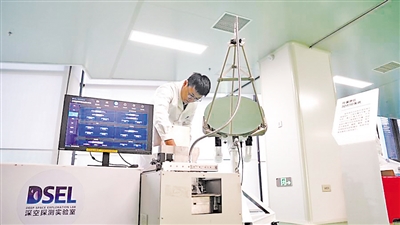
| A researcher demonstrates the lunar 3D printing process at the Deep Space Exploration Laboratory in Hefei, east China's Anhui province, paving the way for moon "houses" built from soil sourced on-site. (PHOTO: XINHUA) |
 |
China will carry out a major project, "Tiangong Kaiwu," during the 15th Five-Year Plan period (2026-2030) to advance space resource development, the China Aerospace Science and Technology Corporation announced on January 29.
The project will build an integrated experimental system and ground support infrastructure, with priority to breakthroughs in small celestial body prospecting, intelligent autonomous mining, low-cost transportation, and in-orbit processing.
Pang Zhihao, a spaceflight technology expert and veteran space writer, said the core of this project is to establish a full-chain system, "prospecting, mining, transportation, and in-orbit processing," to shift deep-space resource use from scientific exploration toward engineering implementation.
This will support lunar bases, deep-space missions, and the space economy.
What are space resources?
Pang explained that all exploitable matter, energy, environments, and information beyond Earth's atmosphere constitute space resources. They can be roughly classified into four categories.
Material resources include helium-3 on the moon, rare precious metals and rare earth elements on asteroids, and water ice on extraterrestrial bodies. These can enable in-situ oxygen and water production, mining, and future nuclear fusion fuel supply.
Energy resources refer to uninterrupted solar power in space, which offers higher intensity and stability than on Earth, enabling space-based solar power stations.
Environmental resources, such as microgravity, high vacuum, and strong radiation, allow production of ultra-pure materials and biological agents impossible on Earth, and provide ideal conditions for astronomical observation and scientific experiments.
Information resources come from communication, navigation, and remote-sensing satellites that build global networks, and space telescopes that capture fundamental cosmic data to support governance and basic research.
"Space resources span from near-Earth orbit to interstellar space," Pang said. "They are a strategic reserve to transcend Earth's limits, carrying both practical value and long-term civilizational significance."
Developing these resources can ease Earth's resource shortages and environmental pressures. This will drive cross-disciplinary advances in aerospace, materials science, and AI, with civilian applications upgrading entire industries. It will also foster new sectors like commercial spaceflight, in-space manufacturing, and asteroid mining, forming a space economy that is a global growth engine.
Crucially, it will expand human survival options through off-world settlements, helping safeguard civilization against planetary threats.
The biggest challenges
Pang said the main obstacles are technological, cost, and regulatory constraints.
Extreme environments pose immediate hurdles: Lunar surface temperatures swing by 300°C, Mars suffers planet-wide dust storms for about one-quarter of the year, and asteroids have near-zero gravity, requiring stable operations under micro- or low-gravity conditions.
Communication delays further limit control. A one-way signal between Earth and Mars can take up to 20 minutes, making remote operation impossible. Systems must rely on AI to autonomously conduct prospecting, mining and fault response, demanding highly reliable algorithms and sensors.
Transportation economics remains prohibitive. Under current technology, shipping raw space ore to Earth costs more than the material's value. Solutions include reusable rockets, in-orbit processing, and electromagnetic launch systems to cut costs.
Realistically, resources should first serve in-space needs, such as refueling or habitat construction, rather than Earth return.
Pang emphasized that while space resource development remains in its early stage globally, it will become a key enabler as we move from an Earth-bound civilization to an interplanetary one.