
 Next
Next


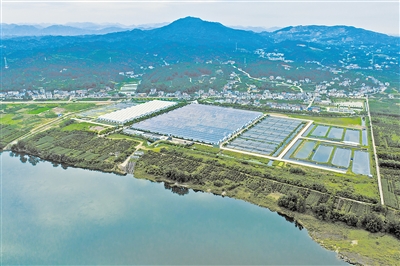 |
| Sturgeon Valley in Yidu, Hubei province. (PHOTO: XINHUA) |
At a sturgeon farm in Yidu, a city in central Hubei province, a new water-recycling system is transforming how fish are raised on land.
Developed by Hubei Qingjiang Sturgeon Valley Special Fisheries Co., Ltd. with support from China's national freshwater fish research team, the system cuts water use by 95 percent, increases output per unit area by more than five times, and ensures over 98 percent of the sturgeon survive transportation across distances longer than 5,000 kilometers.
This technology, known as advanced live sturgeon transport, was included in the first batch of advanced and applicable technologies for science and technology-based poverty alleviation under the Belt and Road Initiative recently released by the China Rural Technology Development Center of the Ministry of Agriculture and Rural Affairs.
It reflects how Yidu, a county-level city, is integrating scientific innovation with industrial development.
Growing fish on land
As environmental regulations restrict traditional net-cage aquaculture in rivers, moving sturgeon production onto land has become essential. Sturgeon Valley therefore adopted a recirculating aquaculture system that reuses and purifies water, making farming both sustainable and efficient.
Transporting large sturgeon, especially those raised for caviar, over long distances used to be a major challenge. Conventional methods often caused high mortality due to stress. The new approach manages every step of the process: capture, temporary holding, sedation, transport, and recovery.
In 2020, the system was tested when 12 tonnes of live sturgeon were shipped from Yidu to Kazakhstan. All the fish survived, setting a record for live sturgeon exports from Hubei.
In October 2025, Sturgeon Valley made its first live shipment to Vietnam, achieving a breakthrough in exports to that market.
Government incentives
Sturgeon Valley's progress is backed by strong local policies. Yidu offers rewards of up to 10 million RMB to enterprises that develop pioneering products, such as new equipment, advanced materials, specialized software, or the first application of a new technology cycle.
Industrial projects led by high-level talents can receive up to 5 million RMB in funding. The city also allocates 3 million RMB each year to support key technological research by local companies.
At a 2025 meeting on business environment and innovation, Yidu distributed 9.55 million RMB in cash rewards and approved 110 million RMB in special loans for science and technology and talent development. These measures have significantly boosted local enterprises' capacity to innovate.
Building an innovation ecosystem
"Yidu's innovation model has shifted from isolated breakthroughs to a systematic approach," said Shen Xiyang, director of the Yidu Municipal Bureau of Science and Technology.
The government, industry, universities, and research institutions are now working together more effectively.
A key player is the Yidu Industrial Technology Research Institute, established in 2022 by Hubei University. It has organized more than 500 expert visits to local companies, finding 55 specific technical needs.
For example, Yidu Huayang Chemical Co., Ltd. was stuck at a critical stage in developing ultraviolet absorbers for over a year. Then Yidu Industrial Technology Research Institute brought in experts, who found a solution in less than two months.
Yidu has also built a demand-driven technology innovation platform in line with provincial strategy. So far, over 650 enterprises have joined the platform, posting innovation requests.
Innovation across sectors
Yidu's innovation efforts go beyond sturgeon farming. The city has nurtured three companies that are among Hubei's Top 100 High-Tech Enterprises and 27 emerging high-tech firms.
One of them, Yichang Dongyang Sunshine Bio-Pharmaceutical Co., Ltd., has been recognized as a "moose" enterprise, a provincial title for fast-growing, high-potential tech companies.
Today, Yidu is focused on turning individual innovations into coordinated industrial strengths. By channeling more scientific resources into real-world production, the city aims to drive high-quality economic growth and realize the vision that "the world looks to China for sturgeon, and China looks to Qingjiang."