

 Next
Next


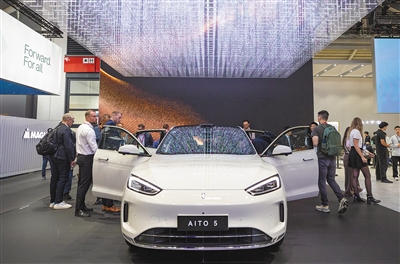 |
| People visit the exhibition zone of Chinese electric vehicle maker AITO at the 2025 IAA Mobility in Munich, Germany. (PHOTO: XINHUA) |
After multiple rounds of consultation, China and the EU have agreed on providing general guidance on price undertakings for Chinese companies exporting battery electric vehicle (EV) passenger cars to the EU, according to China's Ministry of Commerce (MOFCOM).
The European Commission stated that each price undertaking offer will be assessed under the same legal criteria and has committed to conducting each review in an objective and fair manner, in line with the principle of non-discrimination and in accordance with WTO rules.
MOFCOM said, the progress shows both China and the EU have the ability and willingness to properly resolve differences through dialogue and consultation under the framework of WTO rules, and maintain the stability of automotive industrial and supply chains in China, the EU and the whole world.
Upstream and downstream industries in both China and the EU share the expectation that the EU's anti-subsidy case against Chinese EVs will be properly resolved, according to a recent statement by the China Chamber of Commerce for Import and Export of Machinery and Electronic Products.
This resolution will help promote the security and stability of relevant industrial and supply chains between China and Europe, safeguard the broader framework of China-EU economic and trade cooperation, and uphold the rules-based international trade order, the statement added.
China and the EU are deeply integrated in terms of automobile industrial and supply chains. China is a crucial supplier of automotive components, such aluminum wheels and electronic parts, to EU automakers.
Capitalizing on China's technological and industrial chain advantages, European auto enterprises, including Mercedes-Benz, BMW and Volkswagen, have already integrated deeply into China's auto production and supply chains.
Chinese automakers have also deeply integrated in Europe through building factories and establishing research and development centers. BYD has built its manufacturing facility in Hungary. Companies such as NIO and XPeng have design and R&D centers in Germany.
The price undertaking guidance will help better balance different interests. Both Chinese and EU companies can enjoy a more stable and predictable auto industry.
Tu Xinquan, dean of China Institute for WTO Studies, University of International Business and Economics, remarked that proper handling of the EV trade difference between China and the EU underscores the fundamental value of dialogue and cooperation in resolving economic and trade differences.
While this move may not resolve all differences, it does show that in a highly interdependent global industrial system, solving differences needs cooperation and communication. With protectionism generating new uncertainties, the China-EU choice demonstrates that cooperation is a practical and necessary option for sustaining the stability of the global economy.