 Next
Next


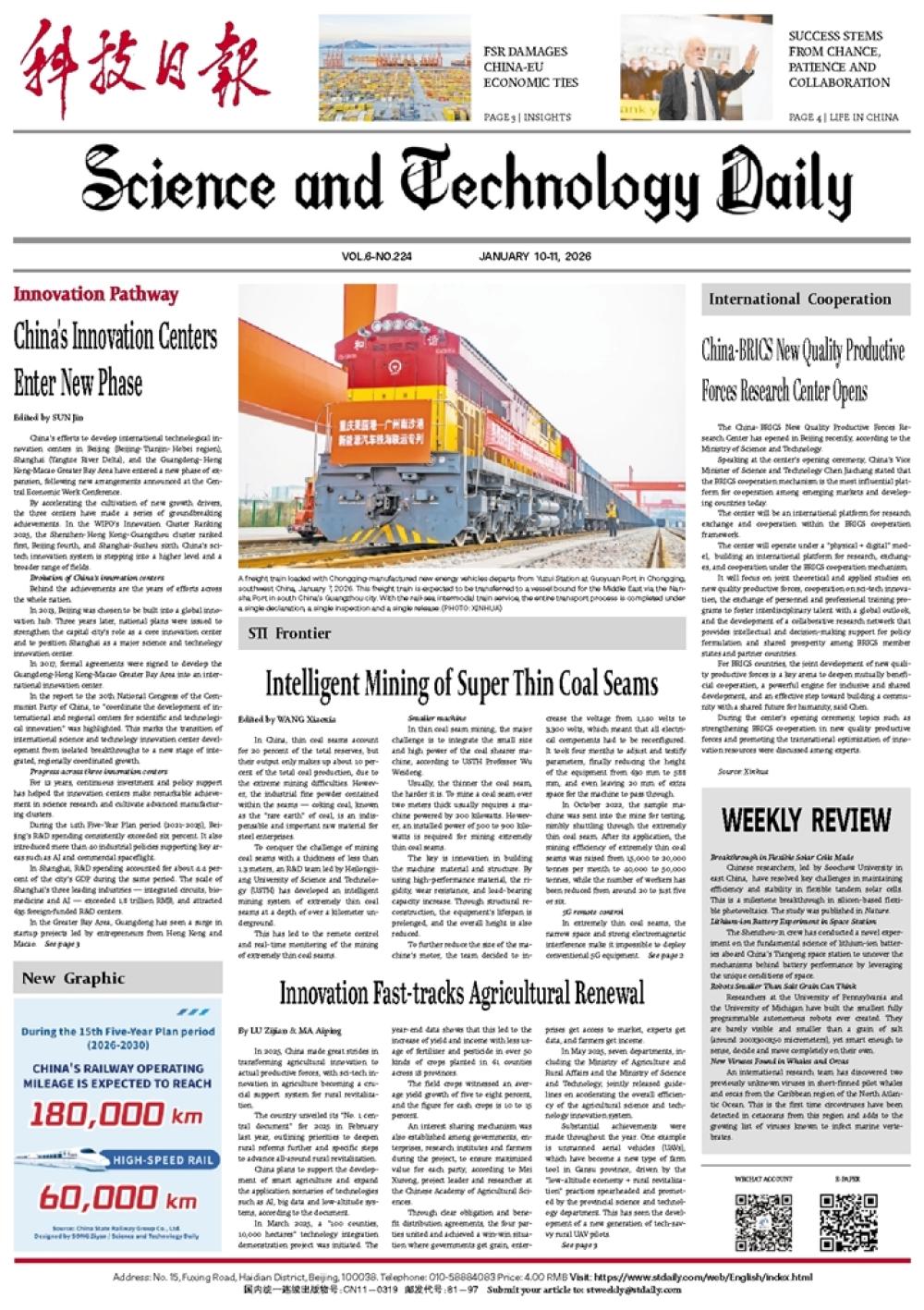
China's efforts to develop international technological innovation centers in Beijing (Beijing-Tianjin-Hebei region), Shanghai (Yangtze River Delta), and the Guangdong-Hong Kong-Macao Greater Bay Area have entered a new phase of expansion, following new arrangements announced at the Central Economic Work Conference.
By accelerating the cultivation of new growth drivers, the three centers have made a series of groundbreaking achievements. In the WIPO's Innovation Cluster Ranking 2025, the Shenzhen-Hong Kong-Guangzhou cluster ranked first, Beijing fourth, and Shanghai-Suzhou sixth. China's sci-tech innovation system is stepping into a higher level and a broader range of fields.
Evolution of China's innovation centers
Behind the achievements are the years of efforts across the whole nation.
In 2013, Beijing was chosen to be built into a global innovation hub. Three years later, national plans were issued to strengthen the capital city's role as a core innovation center and to position Shanghai as a major science and technology innovation center.
In 2017, formal agreements were signed to develop the Guangdong-Hong Kong-Macao Greater Bay Area into an international innovation center.
In the report to the 20th National Congress of the Communist Party of China, to "coordinate the development of international and regional centers for scientific and technological innovation" was highlighted. This marks the transition of international science and technology innovation center development from isolated breakthroughs to a new stage of integrated, regionally coordinated growth.
Progress across three innovation centers
For 12 years, continuous investment and policy support has helped the innovation centers make remarkable achievement in science research and cultivate advanced manufacturing clusters.
During the 14th Five-Year Plan period (2021-2025), Beijing's R&D spending consistently exceeded six percent. It also introduced more than 40 industrial policies supporting key areas such as AI and commercial spaceflight.
In Shanghai, R&D spending accounted for about 4.4 percent of the city's GDP during the same period. The scale of Shanghai's three leading industries — integrated circuits, biomedicine and AI — exceeded 1.8 trillion RMB, and attracted 635 foreign-funded R&D centers.
In the Greater Bay Area, Guangdong has seen a surge in startup projects led by entrepreneurs from Hong Kong and Macao.
More than 250 Guangdong-based companies are now listed in Hong Kong markets, with a combined market value of over 11 trillion RMB.
The success of three international science and innovation centers stems from cross-regional collaboration supported by coordination between the central and local governments.
Take the Beijing-Tianjin-Hebei region as an example. The three places are collaborating on industrial development, jointly mapping out six key industrial chains, including hydrogen energy and biopharmaceuticals.
At the Tianjin Municipal Industry and Information Technology Bureau, Science and Technology Daily reporter saw the map for Tianjin's productivity (2025), where the "Beijing-Tianjin high-tech industrial belt" was highlighted, offering a clear, at-a-glance view of the industrial chain layout.
Future plans for expansion
China plans to further expand its science and technology innovation hubs by strengthening connections between Beijing, Shanghai and a wider group of innovation-oriented cities and areas.
These include Tianjin, Nanjing, Hangzhou, Hefei, Suzhou, Ningbo and the Xiong'an New Area in Hebei.
The goal is to make it easier for resources, talent and research platforms to move across regions and improve the overall effectiveness of regional innovation systems.
A series of practical supporting measures, such as strategic planning for scientific and technological development and policies to foster industrial clusters, are expected in the coming days.
In the Beijing-Tianjin-Hebei region and the Yangtze River Delta, preparations are underway to take on these expanded roles.
Beijing will deepen its role as a regional innovation leader, leveraging its integrated education, science and technology mechanisms to strengthen collaborative research.
Shanghai also announced new measures in 2025 to enhance linkages with the Yangtze River Delta and accelerate the growth of national-level advanced manufacturing clusters.