

 Next
Next


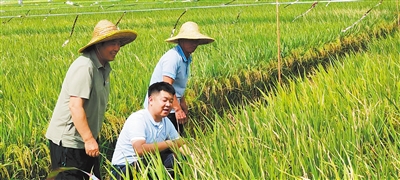 |
| At the rice field of the Shenzhen-Shanwei Special Cooperation Zone, an experts' team screens and identifies varieties. (COURTESY PHOTO) |
Soil salinization has long constrained agricultural productivity in China's coastal regions. Now, to take up this challenge, local authorities in the Shenzhen-Shanwei Special Cooperation Zone in south China's Guangdong province have joined hands with scientists in central China's Hunan province.
Building on the legacy of the late Yuan Longping, the "Father of Hybrid Rice," his former research team has driven a collaborative project that has achieved sustained yield growth in the coastal areas of the Shenzhen-Shanwei Special Cooperation Zone, despite challenging soil and climate conditions.
In February 2023, the Guangdong branch of the Hunan Hybrid Rice Research Center (HHRRC) was established to accelerate the transition from research to field application. Drawing on the successful experience of Hunan province, local authorities introduced a systematic cultivation plan tailored to regional conditions.
The plan included a recommended seed catalogue for early-season and late-season rice, prioritizing hybrid varieties with strong salt tolerance, high yield potential and stable performance, such as "Jingliangyou 3261" and "Zhuoliangyou 1126."
"At the demonstration base, the Jingliangyou 3261 has achieved an average yield exceeding 450 kilograms per mu (about 0.07 hectares) for two consecutive years on soil with a salinity level of 0.3 percent," said Nie Lingli, director of the HHRRC Guangdong Branch. "This is about 50 percent higher than the national average for similar conditions."
As a result, the Shenzhen-Shanwei's rice yield per mu increased by 10 percent in the first year of the program. In 2024, the average yield of early-season rice rose by a further 13.3 percent year-on-year.
To further scale up the achievements, the agricultural science promotion institute of Shenzhen-Shanwei was established.
Through the institute, the Guangdong Branch team successfully secured approval and authorization for multiple salt-tolerant hybrid rice varieties. The team also incubated Shenzhen Xin'an Seed Company, strengthening the link between research institutions and farmers.
"With the institute's technical support, we have promoted over 10,000 mu of hybrid rice seeds," said Yuan Chengwei, general manager of Xin'an Seed.
"We're scaling this project to drive the transformation of Shenzhen-Shanwei's agriculture toward smarter, greener and more precise production systems," said Tang Wenbang, director of the HHRRC. "The goal is to establish a new agricultural paradigm in south China that could also offer valuable experience for other salt-affected regions nationally."