

 |
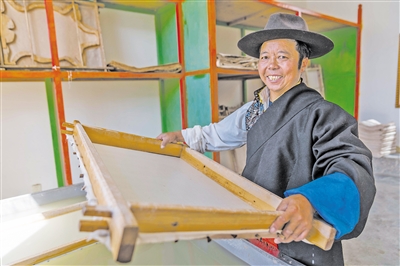
| An inheritor makes Tibetan paper in Lhasa, southwest China's Xizang autonomous region. (COURTESY PHOTO) |
Located at nearly 4,000 meters above sea level, Awang Quyang, 46, is testing a new plant-based dye for Tibetan paper. As a fifth-generation inheritor of the Zhigong Gaxiu Tibetan papermaking technique, listed as a municipal-level intangible cultural heritage in Lhasa, he has helped adapt the ancient craft for modern use.
The workshop, in Tangjia township, Mozhugongka county, Xizang autonomous region, has walls displaying sheets of colored paper, from deep red to indigo, some printed with classical Tibetan scriptures, others with contemporary designs. Nearby are notebooks, pen holders, lanterns, and other products made from this paper, showing how a 1,300-year-old tradition is finding new relevance.
Tibetan papermaking dates back to the 7th century. The unique method has been passed down within one family since the 11th century. Many historical texts preserved in the Potala Palace and Jokhang Temple were written on this paper.
"The paper can last hundreds of years without rotting or being damaged by insects," said Quyang, holding a well-preserved sheet made with traditional methods. The key lies in its raw material: the root of the Langdu plant (wolfsbane), which is naturally toxic and insect-resistant. The process involves more than 10 steps, peeling, boiling, pulping, forming and drying, resulting in paper that is durable, resistant to decay and hard to tear.
For Quyang, the craft carries cultural meaning. "Every step reflects respect for nature and tradition," he said. "We turn a poisonous plant into something useful, a practice built on generations of knowledge."
While keeping core techniques unchanged, Quyang and his team now use eco-friendly dyes, expanding the paper's color range from the original earthy yellow to 12 different shades. They have also developed a version with a leather-like texture.
Quyang began learning papermaking from his father as a teenager. In 2001, while working at a paper mill run by the Caiquan Welfare Special Education School in Lhasa, he traveled to Nepal to study Tibetan paper dyeing. After returning, he introduced what he learned and, in 2013, began his career in Tibetan papermaking in his hometown to continue the tradition.
Recently, his nephew Dainzin Norbu, a 23-year-old computer science graduate, joined his team. "We're developing AR postcards," he said. "When scanned, they show animations of the papermaking process and its history." He believes intangible heritage must connect with young people through new technologies.
Two local youth at the cooperative can now complete the full papermaking process on their own. "This skill has been passed down for generations —not just as a craft, but as part of our identity," said Quyang. He plans to build a hands-on workshop to let more people experience the technique directly.