

 Next
Next


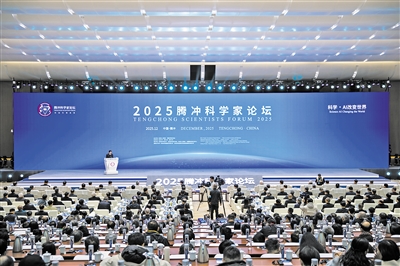 |
| The opening ceremony of the Tengchong Scientists Forum 2025 is held on December 6. (PHOTO: XINHUA) |
The Tengchong Scientists Forum 2025, held in Tengchong city, Yunnan province in southwest China, brought together the world's top scientific talent, including Nobel laureates, Turing Award winners, Fields medalists, and leading Chinese academicians to discuss AI changing the world.
The discussions from December 5 to 8 spanned critical fields like digital security, mathematics, materials science, quantum technology, agriculture, and robotics.
Bridging basic research and application
Turing Award recipient Andrew Chi-Chih Yao, acknowledging AI's potential for good, cautioned about new challenges in digital security. He used biosynthesis technology as an example to warn that large AI language models could be maliciously used to aid in the synthesis of harmful DNA sequences.
To counter this, Yao proposed cross-disciplinary solutions merging biology and cryptography to develop safe, privacy-preserving DNA screening systems.
Fields medalist Efim Zelmanov stressed mathematics as the foundation of AI, pointing out that the core of deep learning techniques is rooted in mathematical principles like polynomial approximation. The foundational logic behind modern applications such as cybersecurity and blockchain can be traced back to the finite fields established by French mathematician évariste Galois in the 19th century.
Nobel laureate Konstantin Novoselov spoke about AI's capacity to expand scientific boundaries. He cited the use of AI and robotics to achieve unprecedented atomic-level precision in developing advanced materials like graphene.
Promoting sci-tech from theory to reality
Pan Jianwei, an academician of the Chinese Academy of Sciences, described the forthcoming era of quantum networks, promising improvements in Internet security and speed. He said in the future, when quantum computing and AI are combined, it will be possible to surpass human intelligence.
His team has reported significant progress in quantum communication and computing, and is developing practical applications like integrated space-ground quantum networks and quantum-enhanced telescopes.
Huang Sanwen, president of the Chinese Academy of Agricultural Sciences, presented a breakthrough in hybrid potato breeding. Using genomic design, his team has developed the world's first hybrid potato capable of propagation from true seed, overcoming the inherent limitations of asexual reproduction.
Huang said the technology could revitalize some 200 million mu (about 13.3 million hectares) of farmland in southern China lying fallow in winter. It could also be extended to 45 vegetatively propagated crops globally, making a scalable contribution to world food security.
Wang Xingxing, founder and CEO of Unitree Robotics, underscored the importance of endowing robots with human-like mobility. "Movement is essential for robots to finish human tasks. We aim to enable robots to execute all human motions."
"The AI data for embodied intelligence is scarce, but this presents the best opportunity for innovation," Wang said. Although robots still face challenges in unfamiliar environments, he thinks that with 30,000 units collecting data globally and continuous AI model optimization, robots could perform 80 percent of tasks in 80 percent unfamiliar scenarios within two years.
Scientific progress is strongest when foundational research, cutting-edge technology and real-world needs converge. The exchanges in Tengchong underscored a common message: AI and related technologies can expand human capabilities and public benefit — if pursued with interdisciplinary collaboration and a focus on accessibility and safety.