

 Next
Next


 |
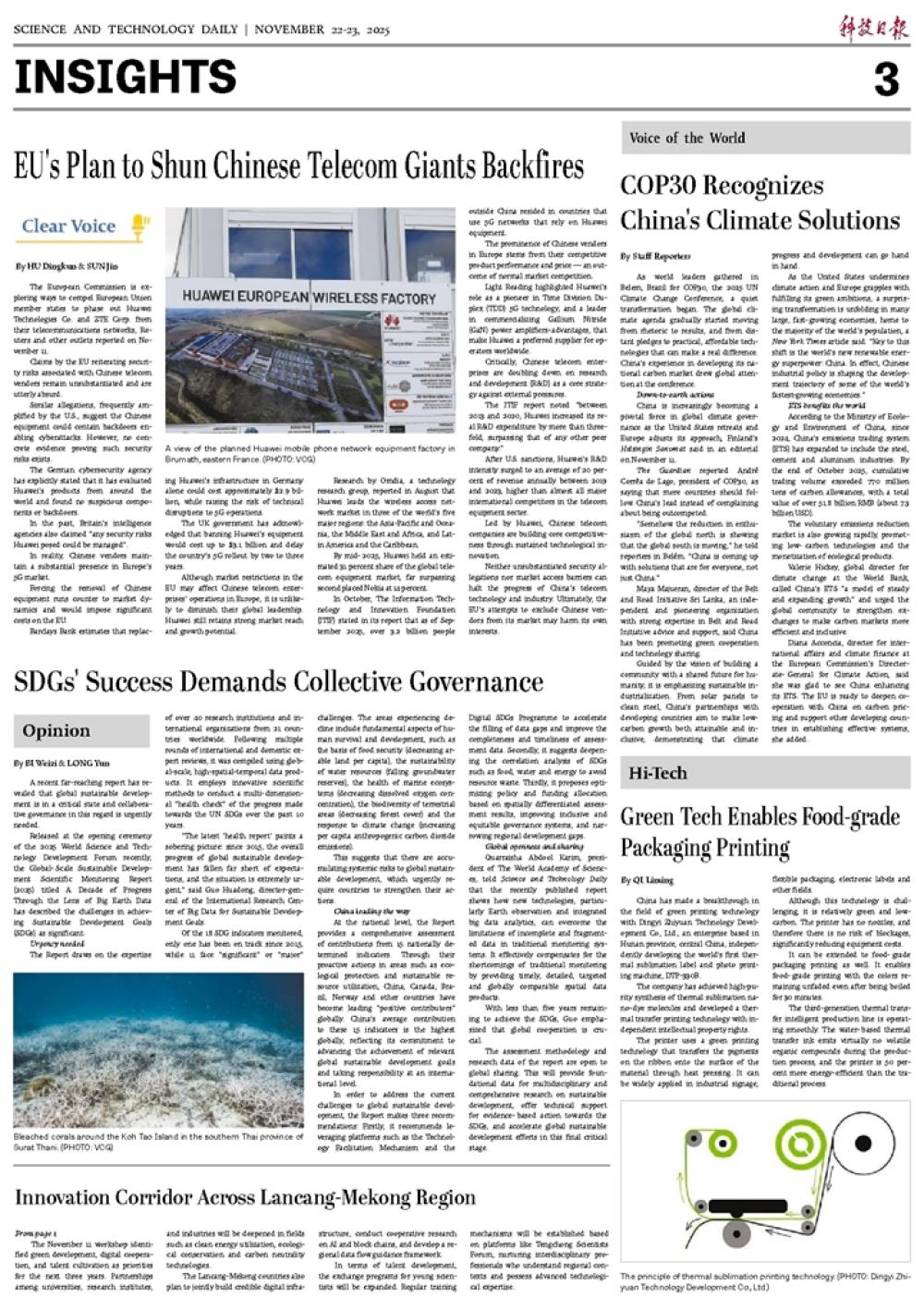
| Bleached corals around the Koh Tao Island in the southern Thai province of Surat Thani. (PHOTO: VCG) |
A recent far-reaching report has revealed that global sustainable development is in a critical state and collaborative governance in this regard is urgently needed.
Released at the opening ceremony of the 2025 World Science and Technology Development Forum recently, the Global-Scale Sustainable Development Scientific Monitoring Report (2025) titled A Decade of Progress Through the Lens of Big Earth Data has described the challenges in achieving Sustainable Development Goals (SDGs) as significant.
Urgency needed
The Report draws on the expertise of over 40 research institutions and international organizations from 21 countries worldwide. Following multiple rounds of international and domestic expert reviews, it was compiled using global-scale, high-spatial-temporal data products. It employs innovative scientific methods to conduct a multi-dimensional "health check" of the progress made towards the UN SDGs over the past 10 years.
"The latest 'health report' paints a sobering picture: since 2015, the overall progress of global sustainable development has fallen far short of expectations, and the situation is extremely urgent," said Guo Huadong, director-general of the International Research Center of Big Data for Sustainable Development Goals.
Of the 18 SDG indicators monitored, only one has been on track since 2015, while 11 face "significant" or "major" challenges. The areas experiencing decline include fundamental aspects of human survival and development, such as the basis of food security (decreasing arable land per capita), the sustainability of water resources (falling groundwater reserves), the health of marine ecosystems (decreasing dissolved oxygen concentration), the biodiversity of terrestrial areas (decreasing forest cover) and the response to climate change (increasing per capita anthropogenic carbon dioxide emissions).
This suggests that there are accumulating systemic risks to global sustainable development, which urgently require countries to strengthen their actions.
China leading the way
At the national level, the Report provides a comprehensive assessment of contributions from 15 nationally determined indicators. Through their proactive actions in areas such as ecological protection and sustainable resource utilization, China, Canada, Brazil, Norway and other countries have become leading "positive contributors" globally. China's average contribution to these 15 indicators is the highest globally, reflecting its commitment to advancing the achievement of relevant global sustainable development goals and taking responsibility at an international level.
In order to address the current challenges to global sustainable development, the Report makes three recommendations: Firstly, it recommends leveraging platforms such as the Technology Facilitation Mechanism and the Digital SDGs Programme to accelerate the filling of data gaps and improve the completeness and timeliness of assessment data. Secondly, it suggests deepening the correlation analysis of SDGs such as food, water and energy to avoid resource waste. Thirdly, it proposes optimizing policy and funding allocation based on spatially differentiated assessment results, improving inclusive and equitable governance systems, and narrowing regional development gaps.
Global openness and sharing
Quarraisha Abdool Karim, president of The World Academy of Sciences, told Science and Technology Daily that the recently published report shows how new technologies, particularly Earth observation and integrated big data analytics, can overcome the limitations of incomplete and fragmented data in traditional monitoring systems. It effectively compensates for the shortcomings of traditional monitoring by providing timely, detailed, targeted and globally comparable spatial data products.
With less than five years remaining to achieve the SDGs, Guo emphasized that global cooperation is crucial.
The assessment methodology and research data of the report are open to global sharing. This will provide foundational data for multidisciplinary and comprehensive research on sustainable development, offer technical support for evidence-based action towards the SDGs, and accelerate global sustainable development efforts in this final critical stage.