

 Next
Next


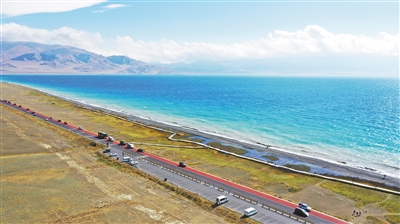 |
| An aerial drone photo shows tourists visiting the Sayram Lake scenic area in northwest China's Xinjiang Uygur autonomous region. (PHOTO: XINHUA) |
Across the Xinjiang Uygur autonomous region in northwest China, a compelling narrative of development has been unfolding, seamlessly weaving technological advancements with deep-rooted traditions.
Spanning smart manufacturing plants and ancient-style dwellings, and bustling cities and revitalized villages, the region is experiencing dynamic growth. At the heart of this transformation lies innovation.
Agricultural progress against environmental odds
Despite its predominantly arid and semi-arid landscape and water scarcity, Xinjiang has achieved remarkable agricultural breakthroughs, defying environmental odds.
This year, Xinjiang's summer grain crops yielded 411.5 kg per mu, exceeding the national average of 375.6 kg per mu, earning it the title of the country's top region for yield growth.
Central to this success is advanced seed science. At the forefront of this effort is Join Hope Seed Co., Ltd. in Changji city in north Xinjiang, where researchers are producing improved seed breeds. "Historically, developing a high-performing seed variety typically took eight to 10 years," Join Hope's Chair She Gang said.
Today, investment in research and development has refined and accelerated the breeding process. Join Hope has developed over 300 high-yield varieties, many of which are sown in Xinjiang's key grain-producing areas. The authorities have contributed to this progress by establishing innovation platforms and technological support services to strengthen the sector.
Innovation goes beyond agriculture
Xinjiang's innovation drive extends beyond agriculture, taking advanced technology to other sectors. Urumqi-based Yinduolan Uighur Medicine Co. exemplifies this transformation. The enterprise has fully automated its packaging line, which has dramatically increased its production efficiency. The automated control system for processing herbal extracts, a pioneering measure, has slashed the production cycle time by 30 percent, energy consumption by 35 percent, and improved extraction yields by 10-20 percent.
TBEA Co., also in Changji, is another company that has undergone technological transformation. From a small factory that nearly went bankrupt in 1998, the company has grown into a major industry player with reported total assets of 207.6 billion RMB in 2024.
Huang Hanjie, CEO of TBEA, attributes the transformation to a significant industry player today primarily to innovation.
A prime example of this is TBEA's digital dry transformer production workshop. It became operational in January 2024 and since then, production capacity has risen by 40 percent.
Surge in tourism
Xinjiang's rich cultural heritage and natural beauty are attracting a growing number of domestic as well as international visitors, bolstered by focused development initiatives.
The popular TV drama My Altay put the Altay region, which has a rich ice and snow culture, on the tourism map.
The local master craftsmen are also contributing to it with their unique art. Sulanbek Shahesh, in his 70s, is an inheritor of the intangible cultural heritage of fur ski making. His workshop promotes the region's winter culture, making traditional fur skis.
The Jiangjunshan Mountain Int'l Ski Resort attracted nearly 550,000 visits during the 2024-2025 season, with revenues exceeding 65 million RMB, reflecting over 20 percent year-on-year growth.