

 Next
Next


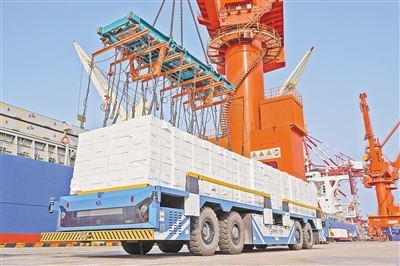 |
| An autonomous truck transports goods at Qingdao Port in Shandong. (PHOTO: XINHUA) |
At Qingdao Port in Shandong province, east China, a remote operator's gentle flick of the joystick sets two gantry cranes — hundreds of meters away — sweeping their booms to scoop iron ore from a waiting freighter.
What once involved enormous physical work now is a matter of quiet precision. "One operator can now control two gantry cranes," said Liu Junhao, an operator. "It not only reduces risks but also boosts efficiency."
Qingdao Port, the world's fourth-largest port and China's second-largest foreign trade port, has improved its independent innovation capacity and accelerated the construction of an intelligent port. From containers, dry bulk and breakbulk to liquid bulk, the port has built an intelligent production system for these four types of cargo and achieved full-process automation for all cargo types.
The widespread use of smart equipment has paved the way for smooth and efficient operations across all the port's terminals. It has helped the port break throughput records continuously and supported the opening of new routes.
In May 2025, the port broke the world record for automated terminal efficiency for the 13th time, reaching an average of 62.62 TEUs per hour per quay crane. Last December, it set its 27th world record in bulk operations, unloading 3,167 tonnes of iron ore per hour.
In its production control center, a web of screens forms a "digital brain," streaming real-time data on ship movements and cargo handling, guiding decisions that keep international logistics corridors functioning smoothly.
"In the early stages, we strengthened the connectivity with the ports of Brazil and Belgium, and smoothed the international logistics channel," said Sun Changjie of Qingdao Port Xilian Company. "We have established efficient transport chains linking sea and land, enabling inland enterprises to export equipment, construction machinery and other materials, as well as import raw materials like pulp. We have successfully achieved unimpeded flow in both directions — with goods available for incoming shipments and outgoing shipments."
Previously, pulp was transported to factories by truck, which often led to shortages in raw material supply, according to a pulp client manager at Qingdao Port. Since the two-way logistics corridor was established, the port has introduced a new transport model and customized solutions, significantly reducing logistics costs and improving delivery efficiency.
Relying on its two-way logistics network, the port has formed comprehensive service advantages such as whole-process logistics, multimodal transport and "one enterprise one policy."
Between January and August this year, the port added five new general cargo routes and laid out more than 40 general cargo routes in total.
While continuing to expand its general cargo network, Qingdao Port has also launched 15 new container shipping routes and three sea-rail lines this year, covering emerging markets such as Southeast Asia, the Middle East and Latin America.
Amid the AI wave this year, the port has seized the opportunity and is pushing into the "AI+Port" sector. It has developed a range of AI-driven innovations, including the Ark TaaS large model, high-voltage shore-power autonomous robots, and intelligent dispatch systems, signaling that China's ports are not just getting busier, but smarter.