

 Next
Next


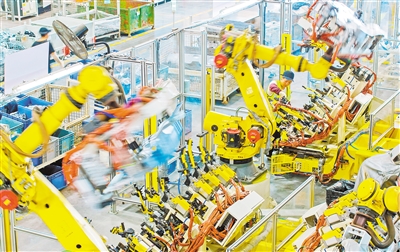 |
| In a company located in east China's Zhejiang province, technicians operate industrial robots to produce components for new energy vehicles. (PHOTO: XINHUA) |
The 20th Central Committee of the Communist Party of China (CPC) convened its fourth plenary session in Beijing from October 20 to 23.
The participants deliberated over and adopted the Recommendations of the CPC Central Committee for Formulating the 15th Five-Year Plan for Economic and Social Development, according to a communique.
This important plenary session and the 15th Five-Year Plan for the 2026-2030 period attracted great attention from the international community. Many foreign media outlets indicated that China's long-term planning is not only vital to its own development but will also have a profound impact on the global economic landscape.
Strategic resilience amid global shifts
Faced with a complex and changing international situation, China has demonstrated strong strategic resilience and development tenacity, a quality that has become a key perspective through which the international community observed the meeting.
The Financial Times quoted Bert Hofman, a professor at the National University of Singapore, as saying: "I think it's a lot of continuity [and] not that much change" with "small nuanced changes" and "no big surprises."
The emphasis on continuity had a "tactical" element, he added. "[There are] lots of things going on in the world, upheaval, but China is continuing to implement their plan towards socialist modernization."
CNN highlighted China's strategic advantage in long-term planning, saying, "China sees an advantage: the long game." The report noted, "The country has raised hundreds of millions out of poverty, transformed into the world's second-largest economy and a global growth engine, and more recently emerged as a technological powerhouse and a proponent of the green transition across the world."
Sputnik News cited Russian Academy of Sciences expert Zakhar Shenkarev, called the 15th Five-Year Plan continuing the logic of the 14th Five-Year Plan while being more flexible, enabling China to respond quickly to turbulent external environments.
Dr. Imran Khalid, commentator for the Pakistan Observer, remarked, "What makes this meeting significant is not the prospect of dramatic shifts, but rather the reaffirmation of a steady, pragmatic vision that has enabled China to weather global uncertainty and maintain momentum as the world's second-largest economy."
A plan to shape the world
The international media and scholars said that due to its strategic layout and global spillover effects, the 15th Five-Year Plan will have significant implications for the global economic landscape and global governance.
The BBC published an article about how China's Five-Year Plans have changed the world, quoting Neil Thomas, a fellow in Chinese politics at the Asia Society Policy Institute, as saying: "Five-Year Plans spell out what China wants to achieve, signal the direction the leadership wants to go in and move the resources of the state towards these predefined conclusions."
History tells us that what hundreds of Chinese leaders decide often has huge repercussions for the world, the BBC said.
The U.S.-based website The Diplomat reported: "Since the 1950s, these centrally formulated plans have served as the backbone of China's economic governance… Each plan sets the tone for the nation's social and economic priorities for half a decade, with ripple effects that extend far beyond China's borders. The upcoming 15th Five-Year Plan is therefore not simply a bureaucratic document; it is the single most important economic roadmap that will shape the direction of the world's second-largest economy through 2030."
India's First Post pointed out: "As the world's second-largest economy and leading manufacturer, China's policy direction influences global supply chains, investment flows, and commodity markets. The meeting's outcomes are particularly relevant to sectors such as semiconductors, renewable energy, electric mobility, and high-end manufacturing, where China's industrial policies could affect competition and pricing worldwide."
Opportunities behind buzzwords
"High-quality development," "innovation," and "high-standard opening up," these key terms from the communique have become focal points in international discourse, reflecting the global community's expectations for opportunities from China.
Japan's Asahi TV said the communique calls for "safeguarding the multilateral trading system" and "boosting consumption." According to the Japanese media, this reflects China's continued commitment to an open economy and multilateral cooperation, which will help stabilize international economic and trade relations.
Scientific and technological innovation, a key driving force of the economy, is being further integrated into the overall national development strategy.
Canada's Digital Journal emphasized that China's vitality comes from innovation. Under the guiding concept of new-quality productive forces, China's innovation system is shifting from being "R&D-driven" to becoming "collaboration-driven." China's "development certainty" has become a scarce global public good.
It is foreseeable that with the formal implementation of the 15th Five-Year Plan, this endogenous vitality will continue to transform into a driving force for global economic recovery, injecting lasting momentum into shared prosperity worldwide.