



 |
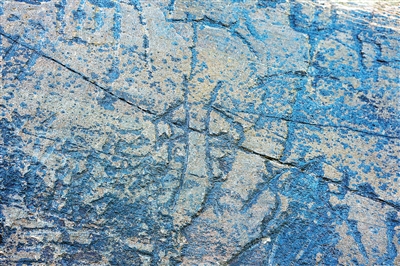
| This photo taken on July 25, 2025 shows the Qin Dynasty engraved stone discovered on the northern shore of Gyaring Lake in Maduo county, Qinghai province. (PHOTO: XINHUA) |
A stone inscription discovered on the Qinghai-Xizang Plateau, known as the "Roof of the World," has been identified as China's only known Qin Dynasty (221 B.C.-207 B.C.) engraved stone still preserved at its original site and the highest-altitude example from that historical period, the National Cultural Heritage Administration (NCHA) announced on Monday.
Located in Maduo county at an altitude of 4,300 meters, the inscribed surface covers approximately 0.16 square meters and contains 37 characters carved in Qin zhuan (seal script). The NCHA confirmed these details after comprehensive field research and expert review.
The inscription was discovered in 2020 by a team led by Hou Guangliang, a professor from Qinghai Normal University. According to Hou, the finding provides early evidence of human activity on the plateau during the Qin Dynasty, offering "vivid historical testimony of China's diverse yet unified civilization."
In June 2025, Tong Tao, a researcher at the Institute of Archaeology of the Chinese Academy of Social Sciences (CASS), suggested in an article that the engraving documented Emperor Qinshihuang's dispatch of alchemists in search of an "elixir of life," who may have stopped at Gyaring Lake near the source of the Yellow River.
While the article drew widespread attention, it also sparked scholarly debate over the inscription's authenticity and dating.
In response, the NCHA organized a multidisciplinary team, including experts from the Chinese Academy of Cultural Heritage (CACH) and the Qinghai Provincial Institute of Cultural Relics and Archaeology, to conduct on-site investigations.
Led by Li Li, vice president of CACH, the researchers employed advanced technology to analyze the inscription. They used high-precision information enhancement technology to collect textual data, macro-photography to examine engraving marks, and portable X-ray fluorescence spectrometers to test the stone's chemical composition.
A key question was preservation: How did the writing survive more than two millennia of exposure?
The research revealed the carving was made on a quartz sandstone formed 250 million years ago. The inscribed panel, facing southeast, was sheltered from the strongest winds and sunlight. Laboratory tests showed the rock has high abrasion resistance and compressive strength, contributing to its longevity.
To rule out forgery, scientists analyzed the tool marks and mineral composition. They found no traces of modern metals such as tungsten or cobalt. Moreover, weathering minerals such as chlorite and illite were present both inside the characters and on the surrounding rock surface, indicating the inscription has undergone ancient, natural erosion.