


 |
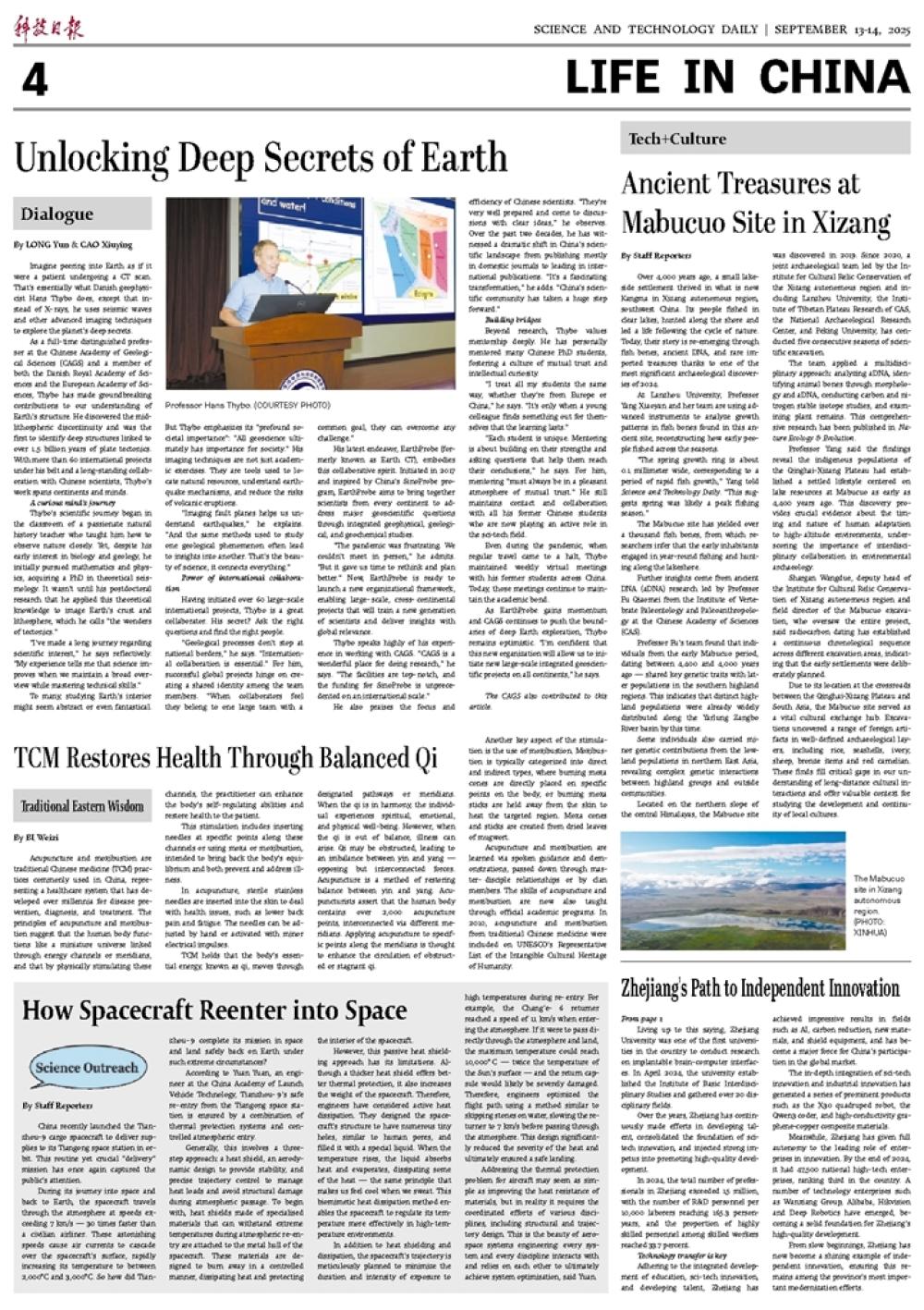
| The Mabucuo site in Xizang autonomous region. (PHOTO: XINHUA) |
Over 4,000 years ago, a small lakeside settlement thrived in what is now Kangma in Xizang autonomous region, southwest China. Its people fished in clear lakes, hunted along the shore and led a life following the cycle of nature. Today, their story is re-emerging through fish bones, ancient DNA, and rare imported treasures thanks to one of the most significant archaeological discoveries of 2024.
At Lanzhou University, Professor Yang Xiaoyan and her team are using advanced instruments to analyze growth patterns in fish bones found in this ancient site, reconstructing how early people fished across the seasons.
"The spring growth ring is about 0.1 millimeter wide, corresponding to a period of rapid fish growth," Yang told Science and Technology Daily. "This suggests spring was likely a peak fishing season."
The Mabucuo site has yielded over a thousand fish bones, from which researchers infer that the early inhabitants engaged in year-round fishing and hunting along the lakeshore.
Further insights come from ancient DNA (aDNA) research led by Professor Fu Qiaomei from the Institute of Vertebrate Paleontology and Paleoanthropology at the Chinese Academy of Sciences (CAS).
Professor Fu's team found that individuals from the early Mabucuo period, dating between 4,400 and 4,000 years ago — shared key genetic traits with later populations in the southern highland regions. This indicates that distinct highland populations were already widely distributed along the Yarlung Zangbo River basin by this time.
Some individuals also carried minor genetic contributions from the lowland populations in northern East Asia, revealing complex genetic interactions between highland groups and outside communities.
Located on the northern slope of the central Himalayas, the Mabucuo site was discovered in 2019. Since 2020, a joint archaeological team led by the Institute for Cultural Relic Conservation of the Xizang autonomous region and including Lanzhou University, the Institute of Tibetan Plateau Research of CAS, the National Archaeological Research Center, and Peking University, has conducted five consecutive seasons of scientific excavation.
The team applied a multidisciplinary approach: analyzing aDNA, identifying animal bones through morphology and aDNA, conducting carbon and nitrogen stable isotope studies, and examining plant remains. This comprehensive research has been published in Nature Ecology & Evolution.
Professor Yang said the findings reveal the indigenous populations of the Qinghai-Xizang Plateau had established a settled lifestyle centered on lake resources at Mabucuo as early as 4,400 years ago. This discovery provides crucial evidence about the timing and nature of human adaptation to high-altitude environments, underscoring the importance of interdisciplinary collaboration in environmental archaeology.
Shargan Wangdue, deputy head of the Institute for Cultural Relic Conservation of Xizang autonomous region and field director of the Mabucuo excavation, who oversaw the entire project, said radiocarbon dating has established a continuous chronological sequence across different excavation areas, indicating that the early settlements were deliberately planned.
Due to its location at the crossroads between the Qinghai-Xizang Plateau and South Asia, the Mabucuo site served as a vital cultural exchange hub. Excavations uncovered a range of foreign artifacts in well-defined archaeological layers, including rice, seashells, ivory, sheep, bronze items and red carnelian. These finds fill critical gaps in our understanding of long-distance cultural interactions and offer valuable context for studying the development and continuity of local cultures.