


 |
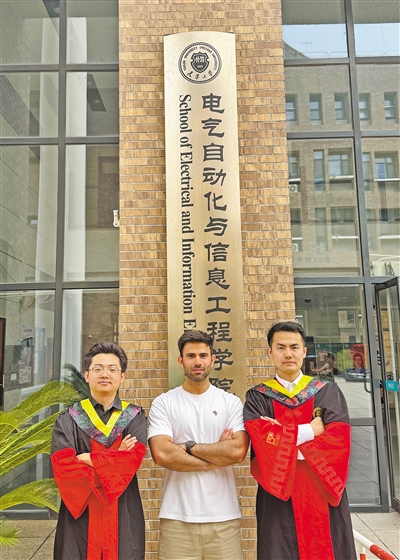
| Muhammad Sarfraz (middle) and his classmates. (COURTESY PHOTO) |
Growing up in the remote village of Dera Ghazi Khan in southern Punjab, Pakistan, Muhammad Sarfraz faced frequent power outages due to dust storms and winds. "From an early age, I was curious about the world beyond my hometown and fascinated by how technology could improve everyday life," he recalls. "I often wondered if there was a more affordable and convenient solution to provide consistent power to these remote communities."
Driven by his curiosity, Sarfraz's academic journey began in Pakistan, where he earned a bachelor's degree in electrical engineering from Sukkur Institute of Business Administration University in 2016. Eager to apply his skills, he spent two years working for a government department in Lahore, developing and maintaining an Integrated Command, Control, and Communications (IC3) system. "This work was valuable," he said, "but it did not fully satisfy my desire to deepen my technical skills and gain advanced knowledge related to my field of interest."
Turning to China, which he said is seen as Pakistan's friendly neighboring country known for its rapid technological development and research opportunities, he completed a master's degree in electrical and automation engineering at North China Electric Power University in Beijing. There, he researched renewable energy forecasting, discovering AI's potential. "AI is revolutionizing how energy systems are integrated, planned and controlled, enabling predictive insights such as estimating remaining useful life, which relates to my work on battery health assessment and lifespan prediction," he explained.
This led him to Tianjin University (TJU) for his doctorate, drawn by its "academic excellence, supportive environment for international students, strong career prospects, and global recognition in research and development." As China's first modern university, TJU embodied a legacy of innovation that mirrored Sarfraz's own aspirations. "Its forward-looking research culture and focus on cutting-edge technologies make it an ideal place for innovation and personal growth," he said.
Life as a doctoral candidate at TJU is a harmonious blend of intellect and exploration. His routine includes lab work on simulations, AI model training, and battery data analysis for AI applications in energy systems, specifically the prediction and optimization of renewable energy storage in urban systems. This research supports China's green energy initiatives and addresses power challenges in developing regions.
Weekends offer a chance to immerse in Tianjin's unique East-West blend. "I enjoy walking along the Haihe River, exploring the Wudadao area, enjoying local street food, or visiting cultural landmarks that showcase the city's unique fusion — from Italian-style streets to French-inspired architecture," Sarfraz said. These outings aren't mere distractions; they fuel his creativity, reminding him how diverse perspectives can spark innovation.
As a Pakistani scholar, Sarfraz sees Tianjin's fusion mirroring the Shanghai Cooperation Organization (SCO) summit aim of "cooperation without losing identity." Like the city's blend of traditions and architecture, the SCO fosters diversity for shared goals in regional security, economic cooperation, trade, technology, sustainability and cultural exchange. It also opens doors for joint research projects, innovations in green energy, and cross-border student exchanges, areas in which TJU leads.
Studying at TJU has fostered Sarfraz's growth. "It has taught me patience, perseverance, adaptability and global thinking," he said. Rigorous research and cultural bridging have turned his challenges into opportunities for growth, collaboration and cross-cultural learning.
Looking ahead, Sarfraz plans to continue in academia and research, focusing on sustainable energy systems and battery technologies. After completing his doctorate, he envisions a postdoctoral position or role at a Chinese R&D institute for a few years to apply what he has learned. Long-term, he looks forward to maintaining ties with China through joint research projects, visiting professorships, or technology transfer initiatives between Pakistan and China.
His ultimate goal is to bring AI-driven solutions back to Pakistan, perhaps improving everyday life in those remote communities that first sparked his curiosity.