
 Next
Next


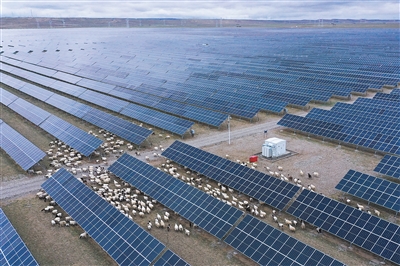 |
| A flock of sheep roaming between solar panels at a solar photovoltaic power plant in Qinghai province. (PHOTO: XINHUA) |
Nestled in the heart of China's ecological civilization, Qinghai province in northwest China is emerging as a powerhouse of clean energy and green innovation. Here, the nation's largest renewable energy base in a desertified area is under construction while the highest-altitude hydropower station along the Yellow River is generating green electricity. Leveraging its abundant clean energy resources, Qinghai is charting a path toward sustainable, high-quality development.
Monitoring with a bird's-eye view
How rich is Qinghai in clean energy? Two key figures tell the story. By June, Qinghai's total installed power capacity was over 759 million kilowatts, with clean energy and new energy accounting for 94.2 percent and 72.6 percent, respectively — both ranking first in China.
Traveling across the province, you can't miss the towering wind turbines dotting the hills or the solar panels crowning village rooftops. But with such a vast, decentralized network of energy facilities, how does Qinghai ensure efficient management? Given the inherent variability of renewable energy, how is real-time generation tracked?
The answer lies in the National Clean Energy and Green Computing Scheduling Center in Xining, Qinghai's capital. Inside the center, large screens display live updates—wind speeds, power output, generator rotations, enabling remote monitoring without on-site visits.
Hu Donggang, deputy manager at Qinghai Green Energy Data Co., explains that the center has integrated data from 28 power companies and 558 renewable energy stations, covering nearly the entire province.
"This system enables unmanned or minimally staffed operations, cutting labor costs by over 40%," he said.
The center also acts as a high-precision command hub, ensuring grid stability through real-time monitoring, remote control, and rapid fault resolution.
Bridging green power and green computing
In the era of digital economy, computing power is the new productivity. With the explosive growth of AI and surging demand for data processing, Qinghai, endowed with ample electricity and a cool climate, is positioning itself as a hub for green computing, aligning with China's "East Data, West Computing" strategy.
Green computing uses clean energy and optimized algorithms to minimize carbon footprints. Zhou Ji, deputy director at State Grid Qinghai's Digital Department, introduced the Computing-Power Collaborative Scheduling Model.
"By analyzing data center loads, time-based electricity pricing, and renewable output forecasts, we generate optimal scheduling curves," he explained. Computing-intensive tasks are done during periods of abundant, low-cost green electricity, slashing emissions.
Currently, Qinghai's intelligent computing capacity has hit 15,000 PFLOPS, while its large data centers maintain an industry-leading power usage effectiveness below 1.2. The center already integrates data from China's three telecom giants and Qinghai University, with plans to include more facilities.
From carbon tracking to global competitiveness
Green computing isn't just about energy. It's about transforming industries. At the operation center, analysts monitor real-time electricity use in industrial parks, offering tailored energy solutions. According to Wang Weiqing, deputy general manager of Qinghai Green Energy Data Co., AI-driven models evaluate 36 metrics, from equipment efficiency to clean energy utilization, creating precise energy profiles for businesses.
For exporters, this means a competitive edge. "Our carbon-tracing database and green-computing certifications help companies navigate global trade barriers," Zhou said. By turning clean energy into verifiable green credentials, Qinghai is deriving both ecological and economic gains.
Today, it is integrating digital intelligence with clean energy, and weaving green computing into national strategies. From wind-swept plateaus to data-driven industries, the province is composing a vibrant anthem for China's green future.