

 Next
Next


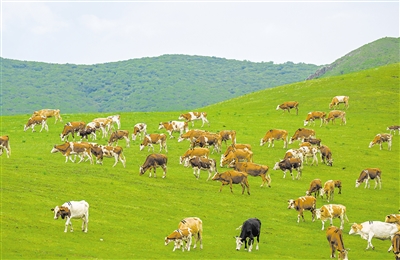 |
| A herd of cattle forage in Chifeng city, Inner Mongolia autonomous region on June 13, 2025. (PHOTO: XINHUA) |
 |
An ambitious plan to establish a more comprehensive, clearly defined, diversified and efficient system for horizontal ecological compensation has been set in motion, after the recent release of a policy document from China's Ministry of Finance, Ministry of Ecology and Environment, and National Development and Reform Commission.
The document, titled "Opinions on Further Improving the Horizontal Ecological Protection Compensation Mechanism," outlines a goal to strengthen collaboration between ecological service providers and beneficiaries. It emphasizes that those who protect and contribute to the environment should be fairly rewarded.
According to the document, by 2027, a unified horizontal ecological protection compensation mechanism for the main streams of the Yangtze and Yellow Rivers will be established. At the regional level, provinces will be expected to implement mechanisms covering major rivers within their jurisdictions. Additionally, steady progress will be made in compensation frameworks related to large-scale inter-basin water diversion projects. Pilot programs will also explore horizontal compensation models for various ecological elements, including forests, grasslands, air, wetlands, deserts, oceans, waterways and arable land.
By 2035, the compensation system is expected to expand to cover the main streams and key tributaries of major river basins, achieving a broader scope, deeper integration, and more innovative methods. This is expected to significantly improve ecological quality and contribute to the national vision of building a "Beautiful China."
To guide implementation, the document prioritizes seven key tasks: establishing a centrally coordinated mechanism for major river basins; supporting local governments in deepening compensation frameworks; expanding coverage areas; diversifying ecological compensation elements; refining compensation standards; innovating compensation methods; and reinforcing platform support.
Notably, for critical river basins such as the Yangtze and Yellow Rivers, the central government will lead the development of a unified compensation mechanism. Under this model, each province's contributions or compensations will be calculated based on water quality data at national monitoring points where rivers enter or exit each jurisdiction, as well as year-on-year water quality changes. This system aims to facilitate fair interprovincial economic transfers while reflecting the value orientation of ecological products.
At the local level, provinces will be encouraged to negotiate interprovincial compensation agreements based on ecological service value and beneficiary clarity. Regions that have already established such mechanisms are urged to further define responsibilities and strengthen targeted protection efforts.