

 |
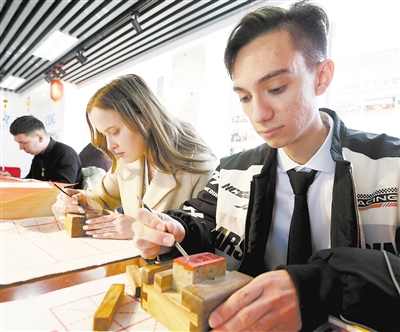
| Foreign students at China University of Geosciences learn Chinese seal engraving to celebrate the Chinese New Year. (PHOTO: VCG) |
Chinese seal engraving, an age-old and esteemed art tradition, has historically been a fundamental aspect of China's cultural legacy. The technique includes carving characters, symbols and motifs onto seals — typically made from materials such as stone, jade and wood — that are subsequently used to authenticate or act as a signature on official documents, artworks and personal letters.
The origins of seal engraving can be traced back to the Shang Dynasty (1600–1046 BC), during which the earliest examples of seals were discovered on oracle bones employed for divination. In this era, seals served as symbols of power, mainly among monarchs and aristocrats. The carving was originally basic, featuring straightforward inscriptions etched onto the seal's surface.
Seal engraving involves three essential techniques: the Zhuan method, layout design and carving methods. The Zhuan technique involves comprehending seal script and organizing characters correctly on the seal surface. Layout emphasizes achieving harmony in the arrangement of elements, taking into account spacing, density and visual movement. Carving techniques utilize different knife methods, such as cutting and pushing, which enable diverse effects, such as precision or fluidity in the engraved lines, creating a unique artistic expression in seal art.
Alongside expertise in traditional calligraphy, the craft of engraving demands a high degree of virtuosity, as the artist operates on a small surface area where every curve and thickness of line is crucial. The highly varied designs are the symbol of the artist's creativity and cultural background.