

 Next
Next


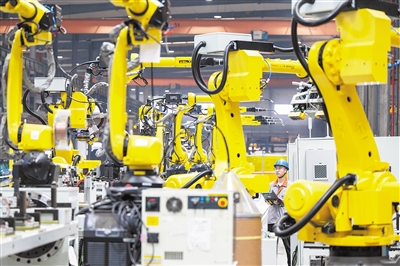 |
| A technician of an intelligent equipment company checks the fully automated production line in Huzhou, Zhejiang province, on May 16, 2025. (PHOTO: VCG) |
 |
China is set to deepen reform and innovation efforts in its national-level economic and technological development zones (ETDZs), following recent decisions by the State Council executive meeting.
The meeting emphasized advancing high-level opening-up policies to stimulate profound reforms and promote high-quality development within these key zones.
These national ETDZs have become pivotal engines for economic growth and international trade. According to data from the Ministry of Commerce, from January to September 2024, China's 229 national ETDZs recorded a total output value of 22.2 trillion RMB by industrial enterprises above designated size, representing a year-on-year increase of 6.3 percent. Their combined import and export volume reached 7.3 trillion RMB, up 10.4 percent, with exports contributing 4.4 trillion RMB and imports accounting for 2.9 trillion RMB. Now, the number of these zones has expanded to 232.
Experts highlight the importance of deepening reforms in these zones to sustain momentum. Zhou Mi, a researcher at the Chinese Academy of International Trade and Economic Cooperation, pointed out that national ETDZs have long served as crucial platforms for attracting foreign investment and driving economic development. "At this critical juncture, the directive to deeply advance reform and innovation in national ETDZs is vital for increasing China's high-level openness," Zhou said.
To enable these objectives, the meeting called for intensified management system reforms and the promotion of efficient "one-stop" administrative services to resolve issues faced by enterprises.
Zhang Xiaotao, dean of the School of International Trade and Economics at Central University of Finance and Economics, stressed that exploring new approaches to high-level openness is intrinsic to national ETDZs' missions. He noted that reforms should focus on dismantling institutional barriers that hinder productivity and innovation. "Building a market-oriented, law-based and international business environment is essential," Zhang said.
Furthermore, the meeting underscored strengthening support in land use, talent cultivation, financing and other critical factors, alongside crafting supportive policies to create a more favorable development environment for the zones.
Looking ahead, Zhou emphasized the need to leverage not only traditional manufacturing strengths but also emerging industries such as AI, big data and biotechnology. Enhancing infrastructure and targeted support policies will empower enterprises, accelerate adoption of cutting-edge technologies, and encourage integration between advanced technologies and traditional sectors.
As China pushes forward, reforming and innovating its national ETDZs is expected to play a crucial role in sustaining dynamic growth and positioning the country competitively in the global industrial chain.