

 Next
Next


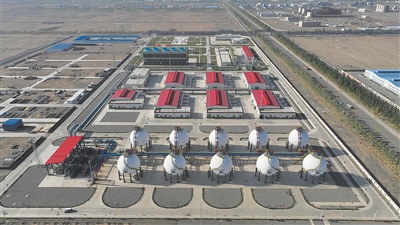 |
| Sinopec's Xinjiang Kuqa Green Hydrogen Demonstration Project in Kuqa, northwest China's Xinjiang Uygur autonomous region. (PHOTO: XINHUA) |
China's largest green hydrogen production project directly using photovoltaic power generation was launched by China Sinopec in 2021 in the Kuqa Economic and Technological Development Zone (Kuqa ETDZ), Xinjiang Uygur autonomous region. This marks a major milestone in the country's pursuit of clean energy.
In 2023, the Kuqa ETDZ was selected as one of China's first national carbon peak pilot zones — the first of its kind in Xinjiang. It is now at the forefront of integrating technological innovation with sustainable, intensive industrial development.
Industrial output surpasses 55 billion RMB
Kuqa is rich in fossil fuel, with proven reserves exceeding 309 billion cubic meters of natural gas and 1.42 billion tons of crude oil — over 90 percent of the Tarim Basin's confirmed reserves. Leveraging this advantage, the development zone has partnered with leading enterprises to integrate innovation and industrial value chains.
One such enterprise, Sinopec Tahe Refining & Chemical Company, operates a major refinery with an annual processing capacity of five million tons. Its gasoline, diesel, and jet fuel products are distributed across China via dedicated railway lines. According to Wang Xingjun, senior supervisor of the production management department of Tahe Refining & Chemical Company, the company is advancing a new integrated project targeting an "850 million tonne refinery + 800,000 tonnes of ethylene + 800,000 tonnes of paraxylene (PX)" model to further elevate the industrial chain.
To support this, Kuqa has developed a comprehensive plan to attract downstream investments in olefins, aromatics, and fine chemicals, while also growing supporting sectors such as textile manufacturing and petrochemical equipment production.
In 2024, the zone's total industrial output exceeded 55 billion RMB for the first time. Key enterprises, such as Sinopec Xinxing Xinjiang Green Hydrogen New Energy Co., Ltd., upgraded operations to meet new industrial standards, driving both scale and quality.
Green hydrogen reduces carbon emissions
The Photovoltaic Green Hydrogen Smart Plant, developed by Sinopec Xinxing Xinjiang Green Hydrogen New Energy Co., Ltd., is a pioneering facility that uses solar power to produce 20,000 tonnes of green hydrogen annually. This hydrogen replaces fossil fuel-based hydrogen in the refining process at Tahe Refining, reducing carbon emissions by 485,000 tonnes per year — the equivalent of planting 280,000 trees.
The project had no existing model to follow. "We overcame technical challenges using industrial internet technologies to synchronize power generation, control systems, and hydrogen production — creating a new smart production model known as the 'load follows generation,' and pioneering the large-scale application of "green hydrogen + refining and chemical" in the industry," said Fan Linsong, executive director of the company.
Cleaner coal and hydrogen ecosystems
Another major initiative in the zone — the "oxygen-enriched combustion and carbon capture demonstration project" — is being spearheaded by Xinjiang Bingneng New Materials Technology Co., LTD. It aims to reduce emissions from traditional coal use by up to 5.7 million tonnes annually.
By accelerating the hydrogen energy value chain, including production, storage, transport, and usage, Kuqa is laying the foundation for a low-carbon industrial future in China's northwest frontier.