


 |
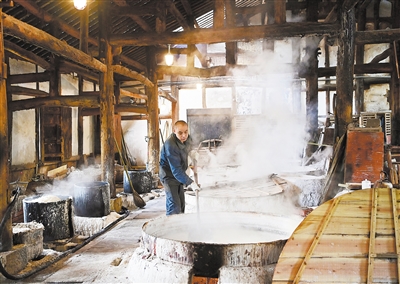
| A staff uses a pot to boil brine to extract salt. (PHOTO: VCG) |
The deep drilling and brine extraction technique of the Zigong well salt, in southwest China's Sichuan province, is recognized as one of China's national-level intangible cultural heritages. Its history can be traced back to the Eastern Han Dynasty (25-220 AD), with a complex process that includes core steps such as drilling, brine extraction, brine concentration through solar evaporation, and salt boiling.
Drilling utilizes the principle of leverage. A rectangular wooden frame is erected, and an iron drill at the other end of the frame is driven up and down by a foot pedal. When the operator suddenly lifts their foot, the iron drill bit strikes the bottom of the well using its own weight, combined with water injection and mud extraction operations until the predetermined depth is reached.
After successfully opening the wellbore, the brine extraction phase begins. The specialized brine extraction tube is made using phyllostachys pubescens (a bamboo species), with a one-way valve made of cowhide installed at the bottom. When the brine extraction tube sinks to the bottom of the well, the pressure of the brine forces the valve open, allowing it to enter the tube. During the lifting process, the weight of the brine presses the valve, closing it automatically. Once the brine extraction tube is removed from the wellhead, the brine can be discharged by using a specialized tool to open the valve.
The extracted brine is opaque and requires concentration through solar evaporation. This step involves selecting a clean, concave area below ground level as the evaporation dam, into which the brine is poured and a bucket wheel device is installed. A pedal is mounted on the side of the bucket wheel, and workers tread on it to drive the wheel to rotate, scooping up the brine from the concave pool and delivering it to the bamboo tube above. The bamboo tube has fine holes drilled on its surface, through which the brine gradually filters out moisture and impurities. It then undergoes a secondary filtration in a filter cylinder before being finally placed in a salt pan and boiled at high temperatures to crystallize into salt.
The deep drilling and brine extraction technique of the Zigong well salt still plays an important role in salt production, due to its advantages of low investment cost and easy operation.