

 Next
Next


 |
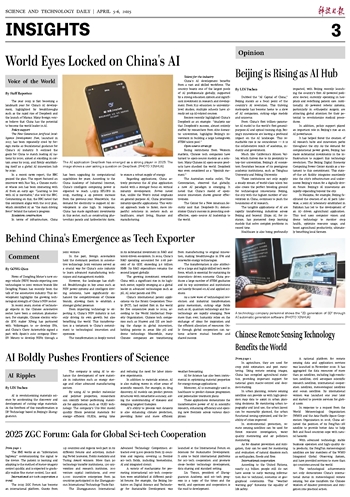
| The AI application DeepSeek has emerged as a strong player in 2025. The image shows a user asking a question on DeepSeek. (PHOTO: XINHUA) |
The year 2025 is fast becoming a landmark year for China's AI development, highlighted by breakthroughs such as the rapid rise of DeepSeek and the launch of Manus. Many foreign voices believe that China has the potential to become the world leader in AI.
Policy support
The New Generation Artificial Intelligence Development Plan, launched in 2017, has been repeatedly cited by foreign media as foundational guidance for China's AI industry. It outlined the goals for China to match leading AI nations by 2020, aimed at excelling in certain areas by 2025, and firmly establishing itself as a global AI innovation hub by 2030.
In a recent news report, the BBC praised the plan. The report featured an interview with Xue Yan, a Chinese mother whose son has been interacting with AI from an early age. "Learning to live with AI is inevitable," she told the BBC. Commenting on this, the BBC noted that this sentiment aligns with the 2017 plan, which identified AI as "the main driving force" behind the nation's progress.
Ecosystem construction
In terms of infrastructure, China has been upgrading its computational capabilities for years. According to the China Academy of Industrial Internet, China's intelligent computing power is expected to reach 1,037.3 EFLOPS in 2025, marking a 43 percent increase from the previous year. Meanwhile, the demand for electricity to support AI development is also high. In response, China has made significant investments in this sector, such as constructing photovoltaic panels and hydroelectric dams, to ensure a robust supply of energy.
Regarding applications, China actively promotes the AI plus application model with a stronger focus on vertical industry development. Forbes noted that, unlike the West's initial emphasis on general-purpose AI, China prioritizes industry-specific applications. This vertical approach leads to faster, more impactful solutions in sectors such as healthcare, smart living, finance and manufacturing.
Talent for the industry
China's AI development benefits from a vast and skilled workforce. The country boasts one of the largest pools of AI professionals globally, supported by a strong education system and significant investment in research and development. From K12 education to university-level studies, multiple schools have already set up AI-related courses.
Reuters recently highlighted China's DeepSeek as an example. "Analysts say that DeepSeek's success, almost entirely staffed by researchers from elite domestic universities, highlights Beijing's investment in building a large homegrown STEM talent pool."
Open-source strategy
Facing restrictions from Western markets, Chinese tech companies have turned to open-source models as a solution. Many Chinese AI open-source products have shocked the world. DeepSeek was even considered as a "Sputnik moment."
The Australian media outlet, The Conversation, observed that globally, a new AI paradigm is emerging. It noted that China's model of open-source innovation shows greater effectiveness.
The Center for a New American Security said that DeepSeek-R1 demonstrates China's success in projecting cost-effective, open-source AI leadership to the world.