

 Next
Next


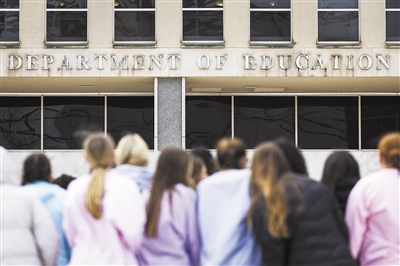 |
| People stand outside the US Department of Education in Washington, DC, USA, on March 6. (PHOTO: VCG) |
U.S. President Donald Trump signed an executive order last week to dismantle the Department of Education "to the maximum extent appropriate and permitted by law."
The move marks a dramatic shift in federal education policy and raises concerns about its impact on international talent exchange and cooperation. The Department of Education plays an important role in shaping the policies that influence foreign student enrollment, research collaborations, and global academic partnerships. Its closure is bound to create uncertainty and disruptions.
One of the consequences would be the effect on international students studying in the U.S. Federal oversight helps ensure that universities maintain programs that attract and support foreign students, including financial aid, visa assistance, and academic exchange programs. Without a centralized authority, there could be inconsistencies in how states manage these programs, potentially leading to confusion for prospective students.
Given that international students contribute significantly to the U.S. economy — both through tuition fees and their participation in research — any decline in enrollment could have long-term financial and intellectual consequences.
The department also serves as an important channel for addressing student grievances related to academics, visas and discrimination. If it is dismantled, international students may struggle to find official support when facing academic disputes, visa complications, or campus rights issues. The lack of a centralized authority would make it more difficult for students to have their rights protected and conflicts resolved efficiently.
Additionally, the closure could disrupt international academic collaborations. Programs like the Fulbright scholarships and university partnerships rely on federal coordination, and decentralization may complicate funding and institutional agreements. This could limit opportunities for American students and researchers to engage in global exchanges.
The decision may also affect skilled immigration. Many international students transition into the U.S. workforce through programs like Optional Practical Training and the H-1B visa. Without clear federal oversight, recognizing educational credentials and securing employment could become more difficult.
While proponents argue that decentralization will improve efficiency and give states more control, the broader implications for international talent exchange cannot be ignored.