

 Next
Next


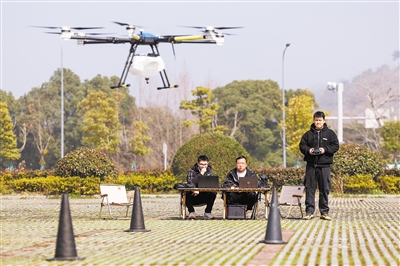 |
| A trainee (R) takes part in a practical drone training session at a low-altitude science and technology innovation base located in Jiangbei district, Ningbo, east China's Zhejiang province. (PHOTO: XINHUA) |
Wu Renbiao, vice president of the Civil Aviation University of China, recently said that the low-altitude economy should be developed in accordance with local conditions. A herd mentality, with everyone rushing headlong into action for now and dropping it in the future, should be avoided.
As an emerging strategic industry, the low-altitude economy is a typical example of new quality productive forces and a blue ocean market with a scale of trillions of RMB.
In recent years, local governments have emphasized it in planning their future industries, regarding it as a new track of economic development. According to incomplete statistics, at least 30 provinces, autonomous regions and municipalities included low-altitude economy-related content in their 2025 government work reports.
However, different regions have distinct differences in terms of their sci-tech level, foundation of their low-altitude industries, natural climate and market demand. If every province rushes headlong to develop the same low-altitude economy industry following the same pattern, it will lead to a mismatch between the path to the industry and the actual conditions in the regions. This will mean low-efficiency development or waste of investment.
To act in accordance with local conditions, local governments in different regions need to find the point where low-altitude economy can be combined with local conditions, and plan their low-altitude industries rationally in order to develop industrial advantages with unique features and ensure high-quality development.
Low-altitude economy requires technological support, such as development of passenger drones with high-level safety, and integrated management of low-altitude transportation and urban transportation.
Therefore, it needs to be developed based on the level of local sci-tech development. For example, regions with abundant higher education resources and advanced science and technology can target frontier low-altitude technologies, plan high-tech enterprises or research forces, and become an innovation highland and technology source of global low-altitude industries.
From raw material supply and core parts manufacturing, to the assembly and production of low-altitude aircraft and guaranteeing and scheduling low-altitude air routes, the low-altitude economy has a long industrial chain and covers many fields.
Different regions can start from their advantageous industries, find the point where the low-altitude industrial chain can be integrated, and take targeted action.
The city of Shenzhen in Guangdong, for example, has built a complete industrial chain for the development and manufacturing of low-altitude technological equipment based on the solid foundation of the local electronic information industry. Fujian province in the east, on the other hand, plans to make use of its advantage in possessing an entire industrial chain of new energy vehicles to develop new energy aircraft like electric planes. With existing industries as the foundation, the low-altitude economy will develop faster.
It has a broad application scale, and localities need to search for suitable application scenarios in accordance with conditions like the geological environment and market demand.
Regions with an advanced energy industry can use drones to patrol oil and gas wells and pipelines; remote areas or complex terrains can use low-altitude aircraft to transport supply and materials; agriculturally advanced regions can use drones to monitor crops and spray pesticide; regions with abundant tourism resources can develop low-altitude tourism. Traditional industries will develop better when empowered by the low-altitude economy.
As the world's largest drone manufacturer and source of technology for drones, China can develop the low-altitude economy with exceptional advantages. As long as its development is planned in accordance with local conditions, its low-altitude economy is sure to soar. In turn it will make people's work and lives more convenient, efficient and comfortable.